Russian chemistry, which includes both academic and industrial domains, is encountering considerable obstacles due to extensive international sanctions and heightened isolation stemming from the ongoing conflict with Ukraine. More than four years after Russia’s incursion into Ukraine, sanctions have impeded Russia’s partnerships with the Western chemical community, including scientific collaboration and training opportunities that were commonplace prior to 2022. This disruption has impacted the involvement of Russian chemists in organizations such as the International Union of Pure and Applied Chemistry, diminishing the level of cooperation to a mere fraction of its pre-conflict state.
Sanctions have halted the availability of vital materials for the chemicals industry, many of which were not produced within Russia before. Irina Timofeeva, a professor of chemistry at St. Petersburg State University, conveys her disappointment that political issues have affected scientific pursuits and decries the Western bias against Russian scientists. She acknowledges the initial severe challenges regarding laboratory reagent supplies but emphasizes the resilience within the community and the motivation to establish domestic production of reagents and scientific apparatus. In spite of the unfavorable political environment, she contends that Russian chemical science has adapted and discovered some advantages.
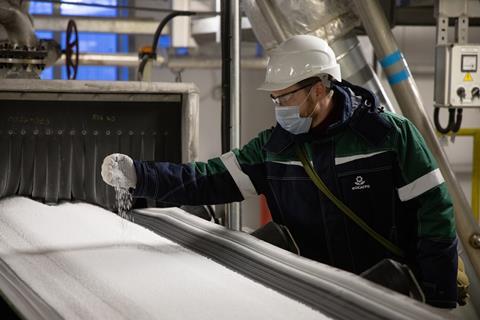
Vadim Popkov, the head of a laboratory at the Ioffe Physical–Technical Institute in St. Petersburg, indicates that sanctions have complicated the landscape in Russia’s chemical industry. Nevertheless, Russia retains robust positions in large-scale chemicals and basic processing, notably in the fertilizer sector, which is experiencing growth with the potential to surpass 70 million tonnes by 2028. Although Western nations will not purchase Russian fertilizers, they can still be exported to third-party countries, particularly in the Global South. Fertilizer production can also aid in the creation of dual-use nitrogen-containing chemicals for munitions.
Popkov observes growth in small-scale fine and specialty chemical production, which has historically depended on imports. New production facilities and clusters are being developed. There is increasing interest in specialized chemistry education, characterized by rising average exam scores and an influx of scientists. While some chemists are leaving Russia, Popkov maintains that the numbers are not concerning.
The Scientific Council on Organic Chemistry of the Russian Academy of Science draws parallels between Russia’s situation and the declining chemical sectors in nations such as the UK and Germany, where chemical production and grant funding are decreasing.