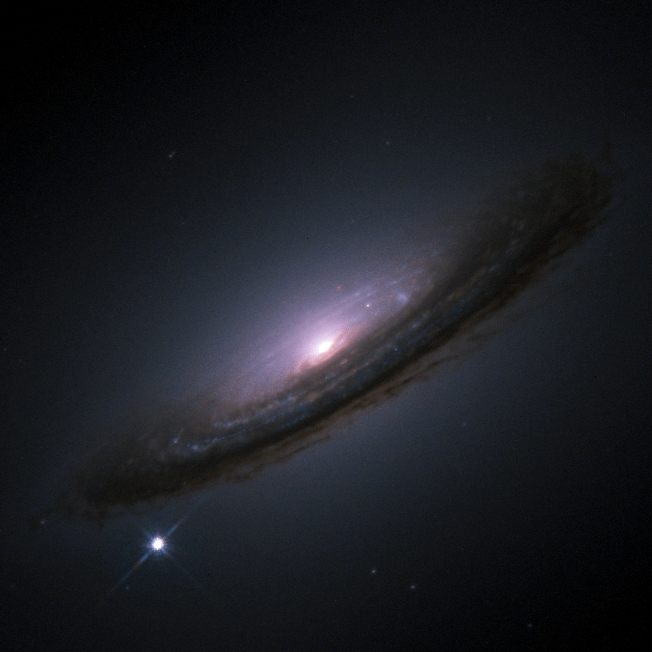
Not every colossal entity exits with a dramatic finale. Some merely cease to consume.
Researchers examining the primordial cosmos have uncovered a colossal galaxy that stopped forming stars not due to a collision but because a black hole at its core kept repelling the resources. The galaxy, dubbed “Pablo’s Galaxy,” thrived just three billion years post-Big Bang, yet it had already fallen silent. Its stars had emerged in a rapid outburst and then, over a relatively brief cosmic interval, the essential ingredients for new ones simply disappeared.
Employing the James Webb Space Telescope and the Atacama Large Millimeter Array in Chile, a team spearheaded by scholars at the University of Cambridge sought out cold gas, the essential fuel for galaxies to create stars. They combed through for nearly seven hours. Their findings were minimal. Less than one percent of the galaxy’s mass was left as usable fuel.
A black hole that kept the reserves depleted
Pablo’s Galaxy is remarkable for its age, approximately 200 billion times the mass of our sun. Most of its stars emerged between 12.5 and 11.5 billion years ago, spanning a timeframe of perhaps a billion years. Then the production ceased.
The Webb telescope illuminated the reason. Neutral gas winds were moving away from the central black hole at about 400 kilometers per second, transporting away around 60 solar masses of material annually. At that pace, any remaining fuel would vanish within tens of millions of years, an instant in cosmic timelines.
What renders this discovery distinct is that the galaxy still appears tranquil. It rotates seamlessly, akin to a pinwheel. There is no indication of a clash or merger, the sort of tumultuous event that astronomers frequently attribute to a galaxy halting star formation. Instead, the black hole seems to have functioned like a gradual leak, continuously heating incoming gas or dispersing it before it could settle and condense.
“You don’t require a singular cataclysm to halt a galaxy from forming stars,” remarked Jan Scholtz from the University of Cambridge. “Simply prevent the fresh fuel from entering.”
A shared destiny?
Prior to Webb, galaxies of this immense size and age were presumed to be rare anomalies. Now they are appearing consistently in the early universe, and Pablo’s Galaxy provides a potential rationale for their formation. The black hole did not disassemble the galaxy. It simply starved it, one portion at a time.
The Cambridge group has already received additional time on the Webb telescope to search for warmer gas surrounding the galaxy, which could indicate whether this subdued form of cessation is the norm rather than merely an exception. For the moment, the discovery serves as a reminder that cosmic demise does not always unfold dramatically. Occasionally, a galaxy simply exhausts its breath.
Nature Astronomy: 10.1038/s41550-025-02751-z
There’s no paywall here
If our coverage has enlightened or inspired you, please contemplate making a contribution. Every donation, irrespective of the amount, enables us to keep delivering precise, captivating, and reliable science and medical news. Independent journalism necessitates time, effort, and resources—your support guarantees we can continue revealing the narratives that matter most to you.
Join us in making knowledge accessible and significant. Thank you for standing alongside us!