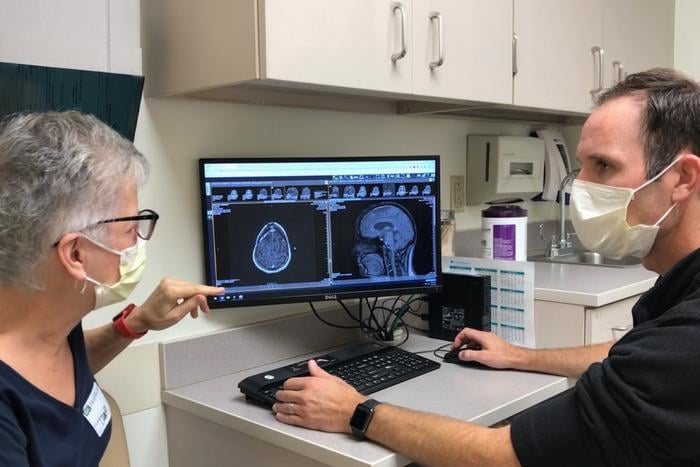
It was a Sunday morning at a youth camp in rural Missouri when Kim Garland began experiencing lapses in memory. Not the common forgetfulness associated with a busy volunteer in her sixties, but peculiar omissions: words that eluded her, names that seemed to vanish, and headaches that appeared and faded unpredictably. Her daughter-in-law was the first to notice these changes. Within days, a scan at a St. Louis emergency room uncovered the reason: a mass roughly the size of a small avocado, positioned in her brain. A biopsy that followed confirmed glioblastoma, grade 4—the most aggressive form of primary brain cancer.
For the majority of individuals who receive this diagnosis, the outlook is bleak and, until recently, almost uniformly predetermined. Surgery, radiation, chemotherapy, and recurrence follow in succession. Median survival typically falls between 12 and 18 months. However, in the three years after Kim Garland’s diagnosis in 2021, researchers at Washington University School of Medicine in St. Louis were quietly exploring an alternative: a vaccine derived from the specific molecular characteristics of her own tumor. Today, nearly five years later, she remains cancer-free.
The findings of that phase 1 clinical trial, released today in Nature Cancer, represent what the researchers highlight as a groundbreaking milestone for glioblastoma. Nine patients were administered customized DNA vaccines, each encoding as many as 40 unique molecular targets specific to their individual tumors. Two-thirds of participants survived at twelve months, compared to the approximately 40 percent survival rate associated with standard treatment. One-third lived beyond two years, a juncture where historical data indicates that only about one in ten would. While this approach doesn’t yet represent a cure, it accomplishes something glioblastoma has persistently resisted for decades: it prompts the immune system to actually recognize the tumor.
A Cold Tumor Turned Hot
Glioblastoma is what immunologists refer to as a “cold” tumor. Its microenvironment—the cellular landscape surrounding the cancer cells—exceptionally suppresses immune activity. It draws in immunosuppressive cells, dampens signaling, and effectively makes itself invisible to the T cells that would normally seek it out. Previous efforts to tackle this issue using checkpoint inhibitors—drugs that have revolutionized treatment for melanoma and lung cancer—have repeatedly faltered in large randomized trials. The tumor simply doesn’t react.
Tanner Johanns, the oncologist heading the trial, had a different intuition. “We opted for a DNA-based platform because it would enable us to target more cancer proteins than any vaccine had previously achieved,” he remarked. “Our hypothesis was that generating a more extensive range of immune responses against these proteins could produce a more effective vaccine compared to other vaccine platforms with narrower protein targets.” The rationale was partly probabilistic: glioblastoma, like all tumors, adapts under immune pressure, discarding the targets the immune system has learned to detect. If you can simultaneously train immunity against forty targets instead of twenty, the tumor has considerably more to conceal.
The feasibility of this approach is made possible by the DNA platform itself. Earlier neoantigen vaccines, such as the peptide-based methods tested in melanoma, face limitations due to synthesis costs, solubility issues, and production timelines. DNA plasmids can accommodate a significantly greater amount of genetic information. Each patient’s vaccine was produced during the six weeks of radiation therapy following surgery, ensuring their personalized treatment was ready by the time they recovered.
Forty Targets per Patient
Reaching forty targets per patient necessitated thoughtful consideration of tumor biology. Glioblastomas exhibit spatial heterogeneity: one region may harbor mutations that are absent in another. A vaccine developed from a single biopsy might completely overlook certain targets. Therefore, the team, in collaboration with computational biologists Obi Griffith and Malachi Griffith on the neoantigen prediction pipeline, extracted tissue from three or four distinct tumor regions during surgery. This strategy increased the number of identifiable variant targets by an average of 45 percent compared to merely sampling the least-mutated region. The vaccine effectively represented a molecular map of the entire tumor, rather than just a fragment of it.
The subsequent immune response was, by most metrics, considerable. In all but one of the patients evaluated, circulating T cells displayed significant activation against the neoantigen targets. The exception was a patient undergoing treatment with dexamethasone, a steroid commonly used to manage brain swelling, known to dampen immune responses. In those patients who demonstrated the most robust T cell activation, survival rates were correspondingly improved: a meaningful positive correlation was observed between CD8 T cell activity following vaccination and overall survival from the time of surgery, indicating that the vaccine was effectively facilitating biological interactions rather than merely yielding technically favorable results that lack real-world translation.
The situation was perhaps most evident in one patient who underwent a second surgery post-vaccination, allowing the team to analyze the tumor microenvironment.