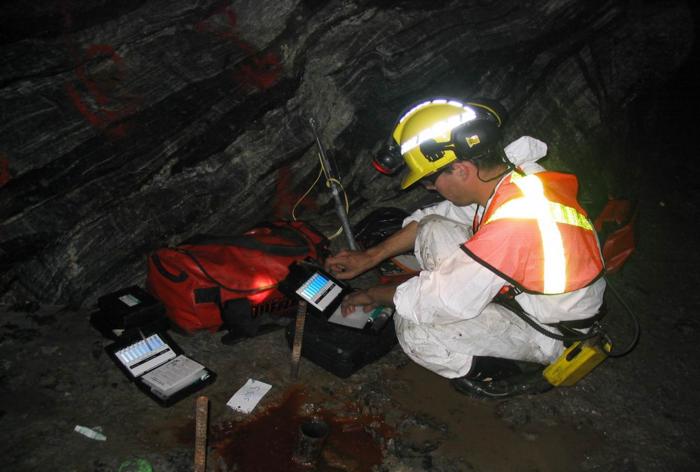
Go deep enough underground in northern Ontario and the surrounding rock is more ancient than nearly everything on the surface of this planet. Approximately a billion years old. Gneisses and granites that predate complex life, that predate the oceans as we recognize them, that have been quietly lying in the dark, engaging in chemical processes, for longer than the mind can truly fathom. And now, near Timmins at active mines, researchers have been crouching beside boreholes, measuring something that geologists have long theorized but never accurately quantified: hydrogen gas, steadily oozing from the Earth’s crust in amounts that could, if the data holds true, genuinely impact the clean energy transition.
The research, released this week in the *Proceedings of the National Academy of Sciences*, is the first to deliver a decade-long empirical record of natural hydrogen emerging from a Precambrian continental environment. Not theories. Not estimates derived from analogous chemistry. Collected data, continually gathered from boreholes at an operational mine, demonstrating that individual boreholes emit an average of about 8 kilograms of hydrogen annually and can maintain that output for 10 years or more.
Eight kilograms may seem trivial. However, the mine site encompasses nearly 15,000 boreholes. Extrapolating yields a figure closer to 140 tonnes of hydrogen per year from a single site, which the researchers estimate represents roughly 4.7 million kilowatt-hours of energy annually. Sufficient, they point out, to meet the yearly energy demands of more than 400 households. “The data from this research suggests there are significant untapped opportunities to harness a domestic source of cost-effective energy generated from the rocks beneath us,” states Barbara Sherwood Lollar, the University of Toronto geochemist who spearheaded the study.
This is termed by professionals in the field as white hydrogen, the naturally occurring kind, distinct from green hydrogen (produced from water using renewable energy) or blue hydrogen (created from natural gas with carbon capture). White hydrogen has garnered increasing attention in recent years, particularly since a substantial discovery in Mali drew interest in 2023. However, the field has faced a deficiency of precisely what Sherwood Lollar and her Ottawa colleague Oliver Warr have now presented: concrete data on the actual gas output and its duration.
The underlying mechanism, broadly speaking, is not enigmatic. “Natural hydrogen is generated over time through underground chemical reactions between rocks and the groundwater within those rocks,” explains Sherwood Lollar. Two processes primarily drive it. Serpentinization, where iron-rich minerals interact with water and release hydrogen as a byproduct, has been understood for decades. Radiolysis, though less renowned, is arguably more crucial in Precambrian contexts: radioactive elements in ancient rocks bombard nearby water molecules, splitting them apart and releasing hydrogen into the surrounding fractures. Canada’s oldest terrains are particularly suited for both of these processes.
### The Rock Does the Work
What renders the Canadian Shield particularly intriguing is a coincidence of geology that Warr articulates with characteristic clarity. “The common link is the rock,” he states. The same ancient Precambrian base that generates hydrogen is also the geological setting that contains Canada’s nickel, copper, and diamond deposits, currently being explored for lithium, helium, chromium, and cobalt. Northern Ontario, Northern Quebec, Nunavut, the Northwest Territories—these areas are already mining territories, implying they have existing infrastructure, boreholes, and personnel on location. “The co-location of mining resources alongside hydrogen production and use lessens the need for extensive transport routes to market, hydrogen storage, and significant hydrogen infrastructure development,” says Warr.
That point of co-location deserves reflection, as one of the ongoing criticisms of hydrogen as a clean energy carrier is the infrastructure dilemma. Green hydrogen, for example, is often produced far from its point of need and is genuinely challenging and costly to store and transport. Compressed hydrogen necessitates heavy tanks and careful handling; liquid hydrogen requires cryogenic conditions. A local source that could be accessed relatively near to an established industrial consumer avoids much of that challenge. Sherwood Lollar is clear about the advantage: “Moreover, this offers a ‘made in Canada’ resource that could potentially support local and regional industrial hubs and reduce reliance on imported hydrocarbon-based fuels.”
The current hydrogen economy is worth examining as well. It is already a $135 billion global industry, largely unnoticed by the public since much of it does not involve cars or fuel cells. The primary use of hydrogen is in fertilizer manufacturing through the Haber-Bosch process; vast amounts are also utilized in steel and methanol production. Almost all of this hydrogen is produced via steam methane reforming, an energy-intensive industrial method that converts natural gas and emits considerable carbon dioxide. Even if one overlooks transportation and decarbonization goals entirely, any cheaper or cleaner hydrogen source has direct implications for existing.