Psychologists have shown a keen interest in reaction times long before psychology became formally recognized as a distinct field. Studies on reaction times are crucial in cognitive psychology because variations in these times under various conditions can reveal insights into the cognitive processing mechanisms at play.
One of the trailblazers in reaction time research was Francis Galton, a notable eugenicist and statistician during the late 19th century. Galton gathered a comprehensive dataset of ‘simple reaction times,’ investigating them as a potential indicator of individual differences in intelligence. He theorized that differences in processing speeds might signal variations in intellectual abilities.
Galton’s dataset provides a rare historical viewpoint, posing the question of whether present-day individuals exhibit quicker or slower reaction times relative to his Victorian-era subjects. If Galton’s theories are accurate, fluctuations in reaction times could unveil generational shifts in cognitive abilities.
The reaction time data presents an intriguing contrast to the well-known Flynn Effect, which outlines a steady rise in IQ scores through generations. The concept of the Flynn Effect tends to baffle those who view younger generations as less capable than those before them, and to those who theoretically anticipate an intellectual downturn due to demographic shifts, like more intelligent individuals having fewer offspring.
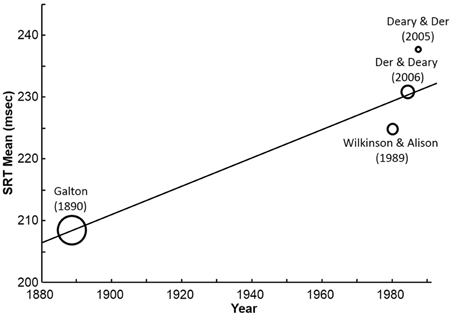
Even though the Flynn Effect suggests an increase in intelligence, the data on reaction times may indicate the opposite. Research that compares Galton’s findings with contemporary data suggests that today’s individuals might exhibit slower reaction times than those from the 19th century. Silverman’s (2010) study, which evaluated Galton’s research alongside 20th-century studies, revealed that the most recent findings reflect longer reaction times than those documented by Galton. This discrepancy, approximately 20 milliseconds, indicates a notable deceleration over a century, suggesting that modern participants are roughly 10% slower.
Understanding these results requires consideration of various elements. The implications of a singular historical dataset should be interpreted with caution since duplicating the conditions with 19th-century participants is impractical. Additionally, there is an absence of intermediary studies that could shed light on trends throughout the years.
Discussions surrounding the significance of these reaction time variations persist. They could point to an actual decrease in cognitive capabilities, heightened cognitive demands in other areas, changes in participant motivation, or shifts in experimental protocols. While reaction times may imply a slowdown, the wider cognitive ramifications remain open for further investigation. Given these complexities, some researchers are reluctant to make definitive assertions regarding generational cognitive decline, advocating for continued exploration.
**References:**
– Irwin, W. S. (2010). Simple reaction time: it is not what it used to be. *American Journal of Psychology*, 123(1), 39-50.
– Woodley, M. A., Te Nijenhuis, J., & Murphy, R. (2013). Were the Victorians cleverer than us? The decline in general intelligence estimated from a meta-analysis of the slowing of simple reaction time. *Intelligence*, 41(6), 843-850.
– Woodley, M. A, te Nijenhuis, J., & Murphy, R. (2015). The Victorians were still faster than us. Commentary: Factors influencing the latency of simple reaction time. *Frontiers in Human Neuroscience*, 9, 452.