It is approximately the size of a paperclip. Nestled on the inner elbow, positioned between two bones, performing a task it was not designed for. The ulnar collateral ligament, or UCL, developed to support a joint intended to swing from branches and throw stones, not to endure the stresses of a major-league fastball hundreds of times each season. And it is deteriorating. Not sporadically, not silently, but at a pace that has emerged as one of professional baseball’s most persistent and costly dilemmas.
Cedric Attias, a graduate student in mechanical engineering at the University of Waterloo, concluded that the challenge required an engineer’s viewpoint rather than a surgeon’s expertise. The outcome, published this January in Multibody System Dynamics, is the initial predictive simulation of baseball pitching designed specifically to understand how a pitcher could deliver the same velocity while placing considerably less strain on that overworked ligament.
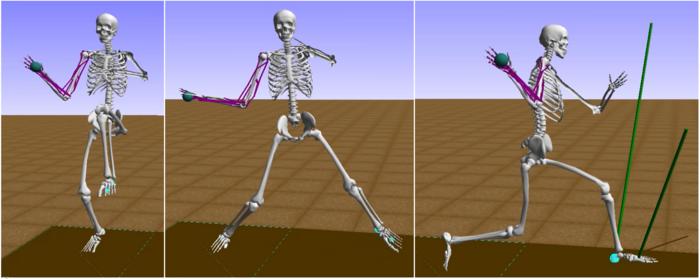
The simulation is constructed in OpenSim, a research tool created at Stanford that enables researchers to craft digital figures with bones, joints, muscles, and the tendons and ligaments tying everything together. Attias and his team developed a model of a major-league pitcher, calibrated using anonymized motion-capture data provided under a confidentiality agreement with MLB, and then processed it through an optimal control framework known as Moco. The software effectively poses a question: if you want to throw the ball at this speed, what motion accomplishes that while minimizing the burden on the UCL? The model iterates thousands of potential solutions, investigating various body positions like a chess engine seeking a superior move.
What they received back astonished even the researchers.
Two mechanical elements were found to significantly influence how intensely the UCL is impacted: the angle at which the arm is positioned at the moment of release, commonly referred to as arm slot, and the extent to which the torso tilts away from the throwing side during the throwing motion. Elevated arm slots and more pronounced contralateral trunk tilt, both characteristics valued in hard-throwing pitchers, are strongly associated with increased ligament stress. The model proposed that pitchers who uphold a more upright stance and a lower arm slot while maintaining similar velocities exert far less strain on that small band of tissue.
“We confirmed that mechanics is critically important,” Attias stated. “We demonstrated that one pitcher throwing 93 miles per hour with controlled, upright mechanics places significantly less stress on the UCL than someone employing a more extreme technique to achieve the same speed.”
To showcase how far the model could be advanced, the team tested it toward extremes in both directions. At the slower end, the motion that minimizes elbow stress while achieving the lowest speeds resembled something already observed in major-league baseball: the submarine delivery of Tyler Rogers, formerly of the Toronto Blue Jays, whose nearly horizontal arm slot appears almost comically dissimilar to the high-over-the-top motion typically encouraged by coaches. At the opposite extreme, the model forecasted that a theoretical pitcher capable of throwing 110 miles per hour, a speed no human has yet attained, would require mechanics more akin to a cricket bowler than a baseball pitcher, featuring a significant trunk lean and an almost vertical arm. Neither end of that spectrum was precisely the objective. The objective was to illustrate that the solution space is broader than most coaches and trainers have assumed.
A Ligament Crafted for the Incorrect Sport
The vulnerability of the UCL stems partly from anatomical misfortune and partly from arithmetic. “This ligament is especially susceptible because it’s small, has poor blood circulation, and wasn’t designed for such extreme or repetitive motions,” Attias remarked. Unlike muscles, which possess rich vascular networks and a reasonable capacity for self-repair after minor damage, ligaments heal slowly and incompletely. A pitcher who throws four hundred pitches weekly throughout a season is expecting a tissue the size of a rubber band to withstand forces nearing its structural limits repeatedly, with limited recovery time between injuries. The cumulative damage is predictable, and the statistics are rather bleak: about a third of active major-league pitchers have undergone some type of UCL procedure.
Tommy John surgery, named for the Dodgers pitcher who was the first to undergo it in 1974, replaces the damaged UCL with a tendon taken from another part of the body. The rehabilitation process takes fourteen months or longer, and some pitchers never return to their prior level of performance. The procedure has become so commonplace that it is nearly unremarkable when announced; this spring, José Berríos of the Blue Jays joined the ranks. What is perhaps more striking is that after fifty years of performing the procedure, baseball continues to produce the same injury at approximately the same frequency.
The simulation method provides something surgical procedures cannot: the chance to avoid reaching that point. “Our aim isn’t to instruct pitchers to throw with less force. It’s to assist them in throwing more intelligently,” Attias stated. This distinction is significant. Pitching velocity is not just a matter of pride; it is a fundamental performance metric on which contracts and careers hinge. Any intervention that truly