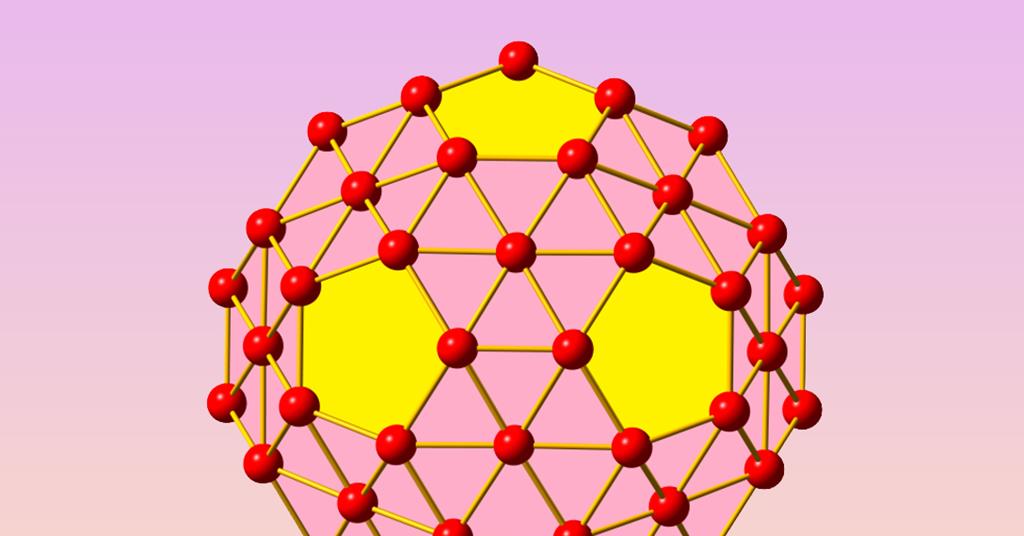
**Boron Buckyball: A Significant Advancement in Nanostructures**
Following two decades of investigation, researchers have successfully isolated an 80-atom boron equivalent of buckminsterfullerene, referred to as B80–, utilizing spectroscopic data to validate its presence. This accomplishment is comparable to the legendary C60 carbon cage, a landmark achievement in nanoscience due to the distinct attributes of such constructs.
Carbon is widely acknowledged for its ability to create various nanostructures, encompassing fullerenes and graphene, each possessing important applications across numerous domains. However, replicating these formations using alternative elements has proven difficult. Boron, a promising option, caught the attention of Lai-Sheng Wang at Brown University for its capability to emulate carbon nanostructures owing to its strong boron-boron connections.
Wang’s quest commenced in the early 2000s with the goal of identifying stable boron configurations. His group achieved a notable milestone in 2013 with the identification of a unique hexagonal form in boron-36, paving the way for the development of two-dimensional boron nanostructures. Continued investigations culminated in the initial experimental detection of a boron fullerene, the B40, which sparked optimism for an 80-atom boron configuration.
In spite of doubts regarding the stability of B80, based on earlier theoretical predictions, experimental advancements have now authenticated its presence. Contrary to the anticipated form of hexagons encircled by central boron atoms, the newly identified structure exhibits a symmetrical design of triangles and pentagons that closely aligns with the geodesic configuration of C60.
The creation of B80– required the generation of clusters through laser vaporization, succeeded by optimal cooling with a helium-argon gas mixture. This technique ultimately unveiled a distinct photoelectron spectrum, definitively validating the existence of the highly symmetric B80 buckyball with a considerable energy gap. The task of experimentally demonstrating stability was tackled through exceptionally diligent experimentation, led by Hyun Wook Choi, a committed student within Wang’s team.
While spectroscopic findings strongly endorse the structure, affirming it as the most stable variant through density functional theory (DFT) computations remains an objective. Current DFT techniques may undervalue the stability of the B80 buckyball, yet ongoing advancements in computational methodologies could facilitate a conclusive comparison with C60 buckminsterfullerene.
The ramifications of this revelation extend far beyond the realm of boron chemistry. As highlighted by Arnout Ceulemans, a theoretical chemist from KU Leuven, this breakthrough paves the way for exploring boron’s potential beyond carbon constructs, emphasizing its unique properties and a promising future in nanotechnology.