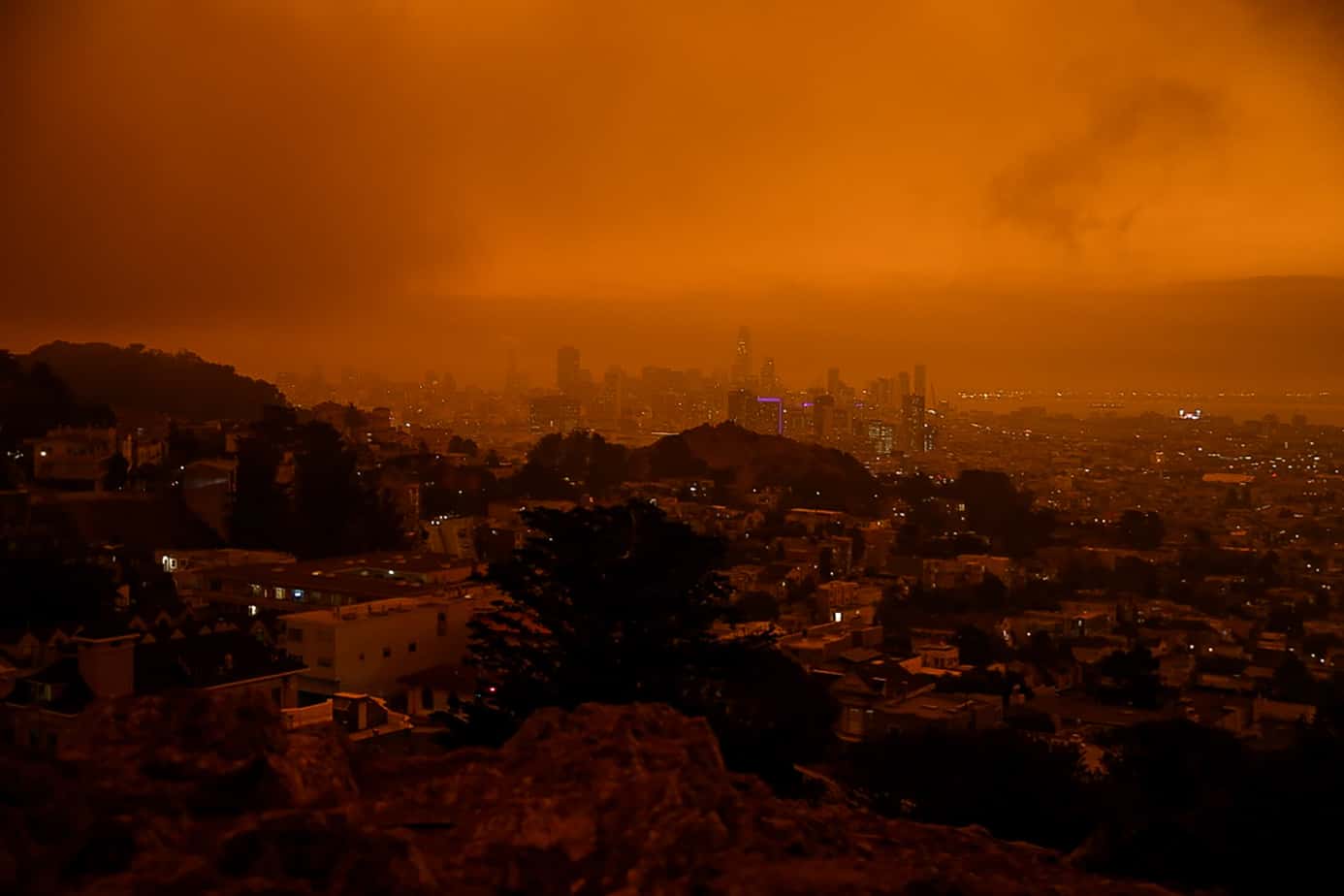
For a hundred years, the approach was straightforward. Spot a fire, extinguish it. This method proved effective, up until it ceased to. All that relentless fire suppression allowed dead wood, brush, and frail young trees to accumulate in ecosystems that were naturally adapted to burn every few years. Consequently, these once-normal forests ignite not in mild ground fires, but in towering, smoke-filled infernos that darken the sky orange over cities located hundreds of miles away.
Thus, here’s a notion that seems a bit crazy: to reduce smoke, ignite more fires. A study released on 11 June in *Science* quantifies this exchange for the first time, and the data, generally speaking, supports it.
The researchers behind this, Iván Higuera-Mendieta and Marshall Burke from Stanford’s Doerr School of Sustainability, were investigating a question that has lingered in fire policy for years. There was a general consensus that prescribed burns, intentional low-intensity fires conducted under controlled circumstances, could mitigate future wildfires. However, these burns also produce smoke. Hence, you’re being asked to accept today’s pollution with the expectation of cleaner air in the future, and no one had determined if this exchange was worthwhile.
“Part of our wildfire issue, and the air quality concerns it raises, is ironically due to the prolonged suppression of fires,” states Burke, the senior author of the study.
A Paradox With Costs
The challenge was data, or rather the scarcity of it. The American West conducts minimal prescribed burning at scale, averaging about 44,000 acres annually compared to over 866,000 acres of wildfire. It is difficult to analyze something that is infrequently performed. Therefore, the team opted for an innovative substitute: sections within actual wildfires that burned at low intensities, resembling what a prescribed burn does to an area.
“It’s a chicken and egg situation,” explains Higuera-Mendieta, the PhD student who spearheaded the research. “How do we study prescribed burning at a large scale? Well, what is it attempting to mimic? It aims to mimic low-severity fire.”
From that point, it was a matter of sifting through two decades of satellite data to construct severity maps for nearly 99% of all wildfires reported in California from 2000 to 2021, totaling over a thousand fires, including the massive 2020 Creek Fire, and then correlating each burned square kilometer with a statistically similar area that hadn’t experienced a fire. The goal was to explore a contrary question: what outcomes would occur if the fire had not impacted this land?
Advantages That Extend Downwind
The results, particularly in conifer forests, were significant. A single application of low-severity fire reduced the likelihood of a very severe wildfire returning to that area by 92 percent, with the protective effects lasting over a decade. Even more surprisingly, the benefits spread outward. Areas within two kilometers of a treated site saw their own fire risk decrease by approximately 43%, with subtle but measurable effects extending as far as five kilometers away.
“You achieve substantial benefits in the treated area,” remarks Higuera-Mendieta. “You also experience benefits that are about half the size but still meaningful in the nearby locations that you didn’t burn. These benefits are essentially ‘free’ from an air quality perspective because you didn’t need to burn them.”
Incorporating this into a simulation of California igniting 500,000 acres of conifers each year, the smoke balance eventually swings favorably. Initially, when wildfires are relatively subdued, all this intentional burning would have increased smoke pollution by roughly 50%. Not an ideal scenario. However, the balance evens out by around year four, and over a complete decade, cumulative smoke decreases by about 10 percent, with the most significant reductions occurring in catastrophic years like 2020 and 2021. Treat the land and compare future smoke reductions to smoke produced, and the benefits outweigh the costs by more than five to one.
Not every ecosystem responds similarly, however. In shrubland, the chaparral prevalent in much of southern California, the protective effect diminished within four years and failed to significantly prevent the most severe fires. In this case, the researchers propose that completely excluding fire might be more beneficial for communities than embracing it.
There are disclaimers, and the authors are candid about them. The study does not account for the asthma attacks or heart ailments or premature deaths that may be averted by shifting smoke, though that evaluation is currently in progress. It presumes that a unit of prescribed smoke affects lungs the same way as a unit of wildfire smoke, which remains unverified. Additionally, it neglects the straightforward financial cost of treatment, which is approximately $170 per acre, give or take, depending on the landscape. The simulations also assume that managers apply fire treatments somewhat indiscriminately, dispersing treatments across all 20 million acres of California conifers rather than specifically targeting the