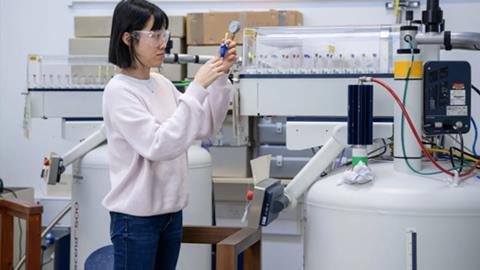
Chemistry departments in the UK are presently not facing significant challenges in obtaining helium, even with worldwide supply interruptions caused by the US–Iran conflict. This reliability is credited to the implementation of helium recovery systems, which allow these departments to sustain standard operations for various analytical instruments.
The ongoing Gulf situation has resulted in assaults on Qatar’s Ras Laffan natural gas facility, eliminating roughly 30% of the global helium supply from the market. Liquid helium is crucial for cooling superconducting magnets in NMR machines and acts as an inert carrier gas in specific mass spectrometry applications. Nevertheless, UK departments report negligible consequences. Cardiff University recently placed an order for 100 liters of helium, and the head of chemistry at the University of Bristol, Craig Butts, indicated that the conflict has had no immediate impact, due to existing supply reserves.
Helium prices have increased by about £2 per liter, as pointed out by Huw Williams from the University of Nottingham. With an annual consumption of 4,500 liters, price hikes can result in added expenses. Luckily, their department employs a helium recycling system that reclaims 80% of the liquid helium utilized. Comparable systems are operational at Edinburgh, Lancaster, Leeds, and Manchester, frequently shared with physics departments that also rely heavily on liquid helium.
These systems have shielded departments from shortages, allowing operations to continue without concerns over helium deficiency. For example, NMR machines, which need regular refilling every four to six months, greatly benefit from recovered helium, averting costly damages and downtime.
Andrew Hall from the University of Edinburgh describes their helium recovery system, installed in 2017 at a cost of around £250,000 and linked to several NMR machines and mass spectrometers. The system gathers helium gas in large plastic bags and compresses it for reuse, cutting helium purchases by 89% and saving approximately £77,000 each year, thus paying for itself within three years.
Beyond monetary savings, the recovery system promotes sustainability. As helium is non-renewable, recycling diminishes CO2 emissions from new gas acquisitions by nearly two-thirds, equating to 540 kg annually. They source electricity primarily from wind and solar energy through the Scottish grid.
Hall states that the upkeep of the recovery system requires effort akin to managing an additional spectrometer. He underscores the significance of the system in ensuring stability amid current uncertainties, allowing chemistry departments to maintain confidence regardless of ongoing global helium supply disruptions.