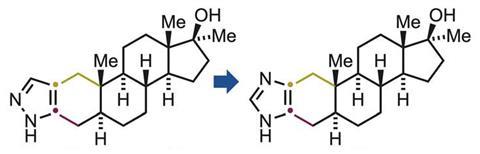
Researchers at RWTH Aachen University in Germany have developed an innovative photochemical reaction that effectively transforms pyrazoles into imidazoles by exchanging a nitrogen and a carbon atom within the molecule, while keeping the rest intact. This cutting-edge approach offers a method to synthesize imidazoles, which play a vital role in medicinal chemistry but are frequently costly or not commercially available, directly from pyrazoles.
Pyrazoles and imidazoles are significant heterocycles in pharmaceutical compounds. Their close structural connection leads chemists to frequently convert pyrazole-based drugs to their imidazole equivalents and vice versa. The newly devised method, spearheaded by Daniele Leonori and his team, revisits research from James Pavlik’s group from three decades ago, who found that UV light could trigger rearrangement of pyrazole. While Pavlik’s initial reactions were hindered by complexity and low yields, Leonori’s group has tackled these issues by fine-tuning the process and demonstrating its effectiveness, encompassing a broad functional group range, including molecules pertinent to medicinal chemistry.
One remarkable application of this approach was the conversion of stanozolol into its imidazole counterpart. Richmond Sarpong from UC Berkeley commended the method for facilitating efficient studies of structural motifs without the need for labor-intensive synthesis, achieving long-sought goals in medicinal chemistry.
The novel reaction mechanism entails photoexcitation, N–N bond homolysis of pyrazole, and the generation of a bi-radical intermediate that subsequently rearranges into imidazole. Employing hydrogen-bond donating solvents such as hexafluoroisopropanol is essential for stabilizing intermediates and ensuring selective imidazole synthesis. Challenges include reliance on UV light, reactivity problems with certain pyrazole derivatives, and sensitivity to the positions of substituents. Scalability for wider application continues to be a hurdle, although flow-chemistry methodologies have demonstrated potential for producing multi-gram amounts.
In spite of these hurdles, the reaction signifies a flexible late-stage scaffold-editing strategy, with ongoing research aiming to apply its principles to additional cyclic systems.