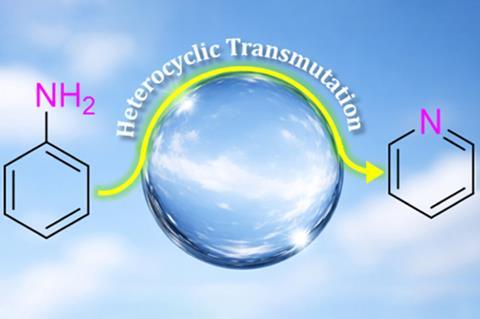
Water microdroplets have surfaced as an innovative instrument in skeletal editing, offering a revolutionary technique for green chemistry in drug design and synthesis. Scientists from India have accomplished a remarkable conversion of aniline to pyridine utilizing solely a delicate mist of water. This reagent-free approach illustrates the distinctive reactivity of microdroplets, indicating a wide-ranging application for synthesizing valuable heterocycles. The precise chemistry occurring within microdroplets is still unclear but likely consists of a blend of ionization and electric field effects that generate hydroxyl radicals, initiating swift chemical transformations. The revelation by Shibdas Banerjee’s team emerged from surprising experimental findings that demonstrated pyridine formation from aniline.
The suggested mechanism entails an attack by hydroxyl radicals on aniline, resulting in a lactone intermediate, which subsequently proceeds through elimination and oxidation stages to yield pyridine. This technique was evaluated on pharmaceutical substances such as niacin and nicotinamide, underscoring its potential. Richard Zare from Stanford commends the environmentally friendly aspect of this transformation, which necessitates only water and ambient conditions. Looking ahead, Banerjee’s team intends to improve the practicality and scalability of this technique by increasing product yield and broadening its application to other chemical systems.