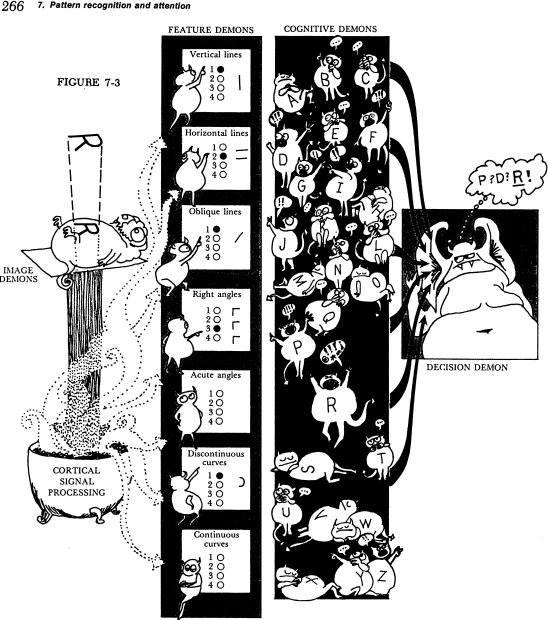
Oliver Selfridge was a crucial player in the initial stages of artificial intelligence (AI) development. In 1959, he presented a revolutionary idea called the Pandemonium architecture. This framework suggested that a network of simple, specialized units could be linked together to perform complex cognitive tasks. Each unit in this framework, referred to as a “demon,” was accountable for a particular function, working together to tackle more intricate challenges. Selfridge’s concepts were innovative for their time, establishing fundamental principles that shaped the growth of neural networks, which are vital to contemporary machine learning technologies.
The Pandemonium model gained attention partly due to its captivating illustrations, especially those created by Leanne Hinton in the 1977 textbook “Human Information Processing” by Lindsey and Norman. These visuals vividly depicted the concept of demons collaborating, showcasing the intricacies of Parallel Distributed Processing in a way reminiscent of a child’s dream world. Although some onlookers described them as resembling a child’s nightmare, many appreciated the illustrations as charming and approachable.
In addition to his contributions to AI, Oliver Selfridge lived a dynamic life. He wrote four children’s books and experienced three marriages. Furthermore, he was involved in uncovering narratives about the National Security Agency’s Echelon program, reflecting his varied interests and significant career.
Despite the frequent connection of the Pandemonium model to its unique illustrations, the artist, Leanne Hinton, often remains unrecognized. While attempts have been made to verify her role as the illustrator, these initiatives have not succeeded, creating a void in the acknowledgment of her role in these notable images.