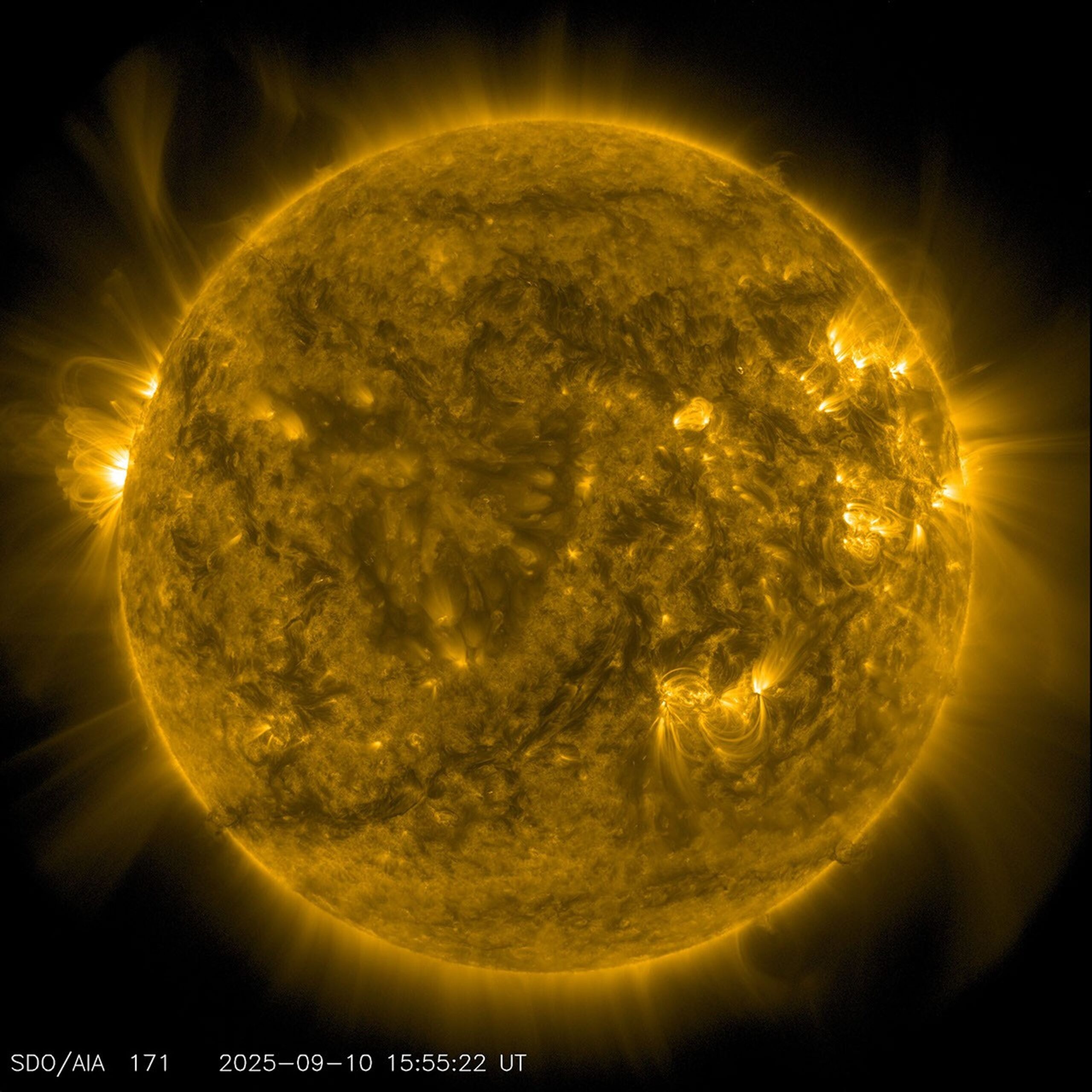
Sunlight requires just a little more than eight minutes to travel the distance between the Sun and Earth. The energy propelling it may have already been on a journey of approximately 170,000 years from the core of the Sun.
This disparity seems unbelievable until the pathway is split into two different environments. Space is clear, allowing light to travel nearly in a straight line. Conversely, the inner solar environment consists of dense plasma, where radiant energy is often scattered, absorbed, and re-emitted, resulting in a movement that resembles random wandering.
I had encountered the figure of 170,000 years before, but I had overlooked the fact that tracking the energy is more precise than envisioning one ancient photon finally making its way to the breakfast table.
Fusion initiates the energy flow
The core of the Sun is approximately 15 million degrees Celsius. At this temperature and under tremendous pressure, a series of nuclear reactions combines hydrogen into helium. A slight mass difference is released as energy.
Some of the energy exits in the form of neutrinos, particles that interact so weakly with matter that most pass through the Sun within seconds. The remainder helps sustain the hot plasma and radiation field within the star. The radiation originating from the core starts at very high energies, but it cannot simply travel directly to the surface.
NASA’s overview of the Sun’s interior categorizes it into the core, radiative zone, and convection zone. NASA estimates a travel duration of about 170,000 years for energy transported by radiation to move from the core to the top of the convection zone.
This is an estimated model rather than a precisely timed journey.
The radiative zone induces the delay
Light continues to travel at light speed between interactions; the extensive delay arises from the brief and aimless nature of those intervals.
The radiative zone extends from just outside the core to about 70 percent of the Sun’s radius. Matter in this region is so dense that radiation frequently interacts with electrons and ions. After an interaction, energy might be redirected outward, sideways, or back toward the center. There is an overall outward movement towards cooler layers, yet no straightforward pathway.
This represents the random-walk dilemma. An individual taking equal steps in random directions will cover significantly more ground than the direct distance from start to finish. More importantly, the required number of steps approximately increases with the square of the distance. Doubling the desired distance can necessitate about four times as many random steps.
In a 1992 study published in The Astrophysical Journal, astrophysicists Robert Mitalas and Kimberly Sills computed the diffusion time using step lengths derived from a model of the current Sun. Their average step length measured a mere 0.090 centimeters. The resulting timescale was 1.7 times 100,000 years.
This calculation is the origin of the well-known 170,000-year figure.
The same photon does not endure the entire journey
Explanations frequently state that a photon “bounces” from the core to the surface. While this is a helpful analogy, it might convey an inaccurate message.
Deep within the Sun, photons can be scattered, absorbed, and re-emitted. Energy transitions between radiation and plasma and its distribution alters as it moves into cooler layers. Thus, it is misleading to visualize a solitary gamma-ray photon maintaining its identity for 170,000 years before emerging as yellow sunlight.
An OpenStax discussion on energy transport in the solar interior provides a broader estimate of 100,000 to 1 million years from the center to the surface. This range serves as a helpful reminder that the answer relies on the solar model, the included interactions, and the exact point at which the timer is stopped.
The 170,000-year approximation specifically describes radiative diffusion to the upper part of the convection zone. It should not be interpreted as a birth certificate for any single photon arriving at Earth today.
A valuable comparison exists at the core. Neutrinos are also generated during the fusion processes, but they scarcely interact with matter. Most escape the Sun within mere seconds, then require approximately the same eight minutes as light to traverse to Earth. Instruments detecting solar neutrinos are consequently receiving a much more prompt signal from nuclear reactions than telescopes observing visible sunlight.
This discrepancy is one reason physicists were keen on measuring solar neutrinos. The visible surface reveals how energy ultimately manifests.