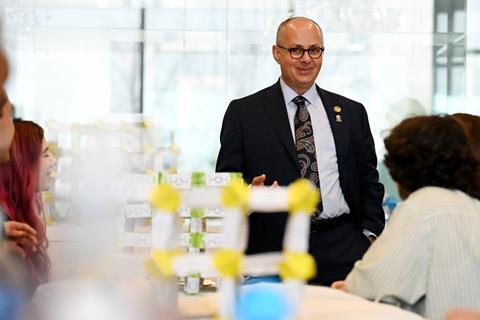
The exit of reticular chemistry trailblazer Omar Yaghi from the United States has stirred considerable attention nationwide. Earlier this month, he departed the University of California, Berkeley for China, prompting a surge of media coverage. Key outlets such as The New York Times, the Los Angeles Times, and Forbes reported on his relocation, marking a rare occasion where an academic’s transition captured headline news. However, Yaghi is not an ordinary academic; he was honored with the chemistry Nobel prize last year for his role in co-developing metal–organic frameworks (MOFs).
Yaghi began his tenure at Tsinghua University in Beijing in early July and is set to head the establishment of the new Artificial Intelligence Chemistry and Materials Research Institute at the university, which aims to develop innovative AI-driven technologies for materials design and synthesis.
This unparalleled attention on an academic’s relocation to another institution seems to reflect a growing unease regarding the Trump administration’s approach to science and research funding. Born in Jordan to a refugee family originally from Palestine, Yaghi holds Jordanian, American, and Saudi citizenship and has publicly criticized the current administration’s budget cuts to U.S. federal research agencies and its immigration policies.
In an interview with China Global Television Network immediately after joining Tsinghua, Yaghi remarked that China is ‘a particularly impressive nation’ and that it is ‘quickly advancing almost every facet of science and technology’. He noted that this progress stems from a persistent ‘commitment to funding research at a scale that enables scientists to investigate and develop new concepts’.
Yaghi has connections to Tsinghua, having been made an honorary professor in January 2022.
When approached for a comment regarding Yaghi’s transition overseas, UC Berkeley congratulated him on his appointment at Tsinghua but refrained from disclosing whether he had disassembled his lab or took any of his PhD students, postdocs, or research grants along. The university simply stated: ‘We appreciate all that he has contributed to UC Berkeley.’
A cautionary note
Neal Lane, a physicist who served as a science adviser to former President Bill Clinton and previously led the US National Science Foundation (NSF), states that Yaghi’s exit should act as a warning. ‘The administration’s policies are eroding the foundations of America’s science and jeopardizing the nation’s future,’ Lane tells Chemistry World.
Moreover, Lane voices concern that the NSF’s decision to prohibit research collaborations with specific Chinese universities will ‘impede America’s advancements in science and technology by severing a crucial source of expertise’. He calls on Congress to ‘pay attention’.
The matter revolves around a policy proposed by the NSF on July 8, set to take effect on October 1, prohibiting U.S. colleges and universities from collaborating with numerous Chinese researchers and other entities featured on the U.S. government’s restricted parties lists. Esteemed Chinese research institutions are among those listed, including Nanjing University, Beijing Institute of Technology, and the University of Science and Technology of China.
Jeremy Berg, a biochemist who formerly directed the US National Institutes of Health’s National Institute of General Medical Sciences, also expresses concern. ‘I worry that Professor Yaghi’s situation may reflect more “push” than previous instances, with the decimation of NSF, loss of students and postdoctoral fellows, even at prestigious places like UC Berkeley, and the ongoing attacks on universities and science across the U.S.,’ he remarks.
Yaghi is not the inaugural US-based chemistry Nobel laureate to relocate to China in recent years. In 2023, Fraser Stoddart, who shared the Nobel prize in chemistry in 2016 for his work on molecular machines and passed away at 82 at the end of 2024, moved to the chemistry department at the University of Hong Kong.
Stoddart, who held dual British and US citizenship, openly criticized the Trump administration. ‘I don’t want to toot my own horn, but I anticipated this and it influenced my decision to relocate from the US to Hong Kong last year,’ he shared with Chemistry World after Trump won re-election in November 2024. ‘I felt it was very likely Trump could become president again, and I really did not wish to continue living in the country,’ he added at that time.
Prominent chemists relocating to China
In July, Zhang Wei, who chaired the chemistry department at the University of Colorado Boulder and had been a faculty member there for 19 years, returned to China to join Great Bay University (GBU). Born in China, Zhang was appointed deputy dean of Great Bay’s school of physical sciences.
In late April 2025, the troubled former chair of Harvard University’s chemistry department, Charles Lieber, who was found guilty of failing to disclose significant Chinese funding in December 2021 and sidestepped a prison term in April 2023 after