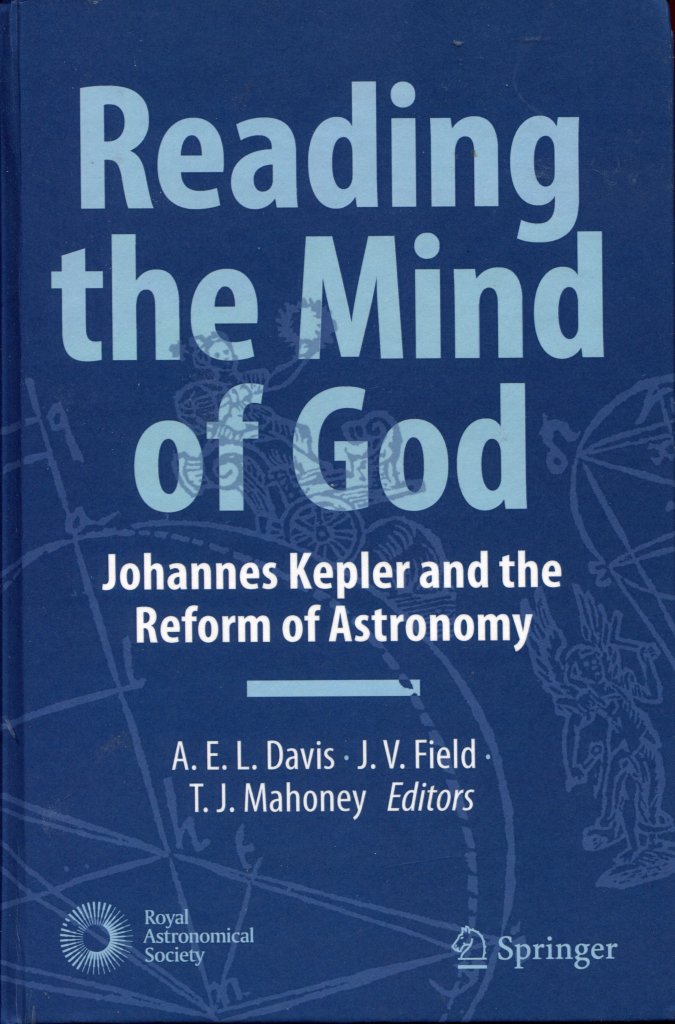
In the early 1600s, Johannes Kepler became a crucial figure in science. His contributions to astronomy and mathematics have frequently been eclipsed by peers such as Galileo Galilei. Nevertheless, many academics contend that Kepler’s work established a more substantial groundwork for modern science, ranking just behind Sir Isaac Newton in that century. The scarcity of literature regarding Kepler, in contrast to that available on Galileo or Newton, raises issues about the acknowledgment of his contributions.
To address this deficiency, the book “Reading the Mind of God: Johannes Kepler and the Reform of Astronomy,” edited by A. E. L. Davis, J. V. Field, and T. J. Mahoney, aims to provide a thorough examination of Kepler’s life and scientific legacy. Published by Springer and The Royal Astronomical Society, this volume seeks to make Kepler’s accomplishments accessible to astronomers and undergraduate students who may not engage with specialized history of science texts.
The origin of this collection dates back to 2009, when the International Year of Astronomy commemorated the four-hundredth anniversary of Galileo’s telescopic discoveries and the release of Kepler’s “Astronomia nova.” During the International Astronomical Union’s General Assembly in Rio de Janeiro, a session focused on Kepler’s life led to the formation of the Johannes Kepler Working Group (JKWG), which initiated the project that resulted in this book.
The book opens with an introductory chapter that places Kepler within the wider history of science, highlighting his contributions to astronomy, optics, mathematics, music, and astrology. This establishes the context for the subsequent chapters, each exploring different facets of his work.
Charlotte Methuen’s paper “Kepler, Religion and Natural Philosophy: A Theological Biography” investigates the significant impact of Kepler’s theological beliefs on his scientific endeavors. Grasping Kepler’s perception of God as a mathematical entity offers insight into his commitment to uncovering a logical, mathematical universe.
J. V. Field’s essay, “Kepler’s Cosmology,” looks at how Kepler’s religious beliefs influenced his cosmological concepts. It examines pivotal works like “Mysterium Cosmographicum” and “Harmonice Mundi,” illustrating their essential role in his scientific pursuits.
T. J. Mahoney’s “Measuring the Heavens: How Tycho Brahe Revolutionised Observational Astronomy” acts as a precursor to Kepler’s astronomical reforms, detailing Tycho’s crucial data gathering that facilitated Kepler’s breakthroughs.
A. E. L. Davis’ chapter “Kepler’s Discovery of the Planetary Orbit: The Goldilocks Solution” details Kepler’s complex journey in formulating his laws of planetary motion. While enlightening, the technical nature of this chapter might present a challenge to the target audience.
The book also addresses translations and the relevance of Kepler’s Latin titles, as Andrew Gregory examines the intricacies of the title of “Astronomia nova.”
Sheila J. Rabin’s essay “Kepler and the Reform of Astrology” offers context regarding the period’s astrological customs and their effect on Kepler, followed by W. H. Donahue’s analysis of Kepler’s groundbreaking advancements in optics.
J. V. Field returns with a discussion about the relationship between Kepler and Galileo, especially their differing perspectives on comets, while her examination of the longevity of the “Rudolphine Tables” emphasizes Kepler’s lasting influence.
Jay M. Pasachoff connects Kepler’s work to modern astronomy, emphasizing its importance in early planetary transit observations and contemporary space missions such as NASA’s Kepler spacecraft.
Eberhard Knobloch investigates Kepler’s mathematical contributions, linking them with the scientific needs of the time, although some contextual explanations are limited.
Finally, Jarosław Wloarczyk presents “Kepler’s Dream and Lunar Astronomical Phenomena,” shedding light on how Kepler’s early writings informed his later heliocentric arguments.
The book concludes with W. H. Donahue’s reflections on translating Kepler, uncovering historical obstacles to the broad dissemination of his works and providing a detailed glossary and index. Despite its initial high price, the reduced rate from Springer makes it an essential purchase for those looking to value the full extent of Kepler’s contributions to science.