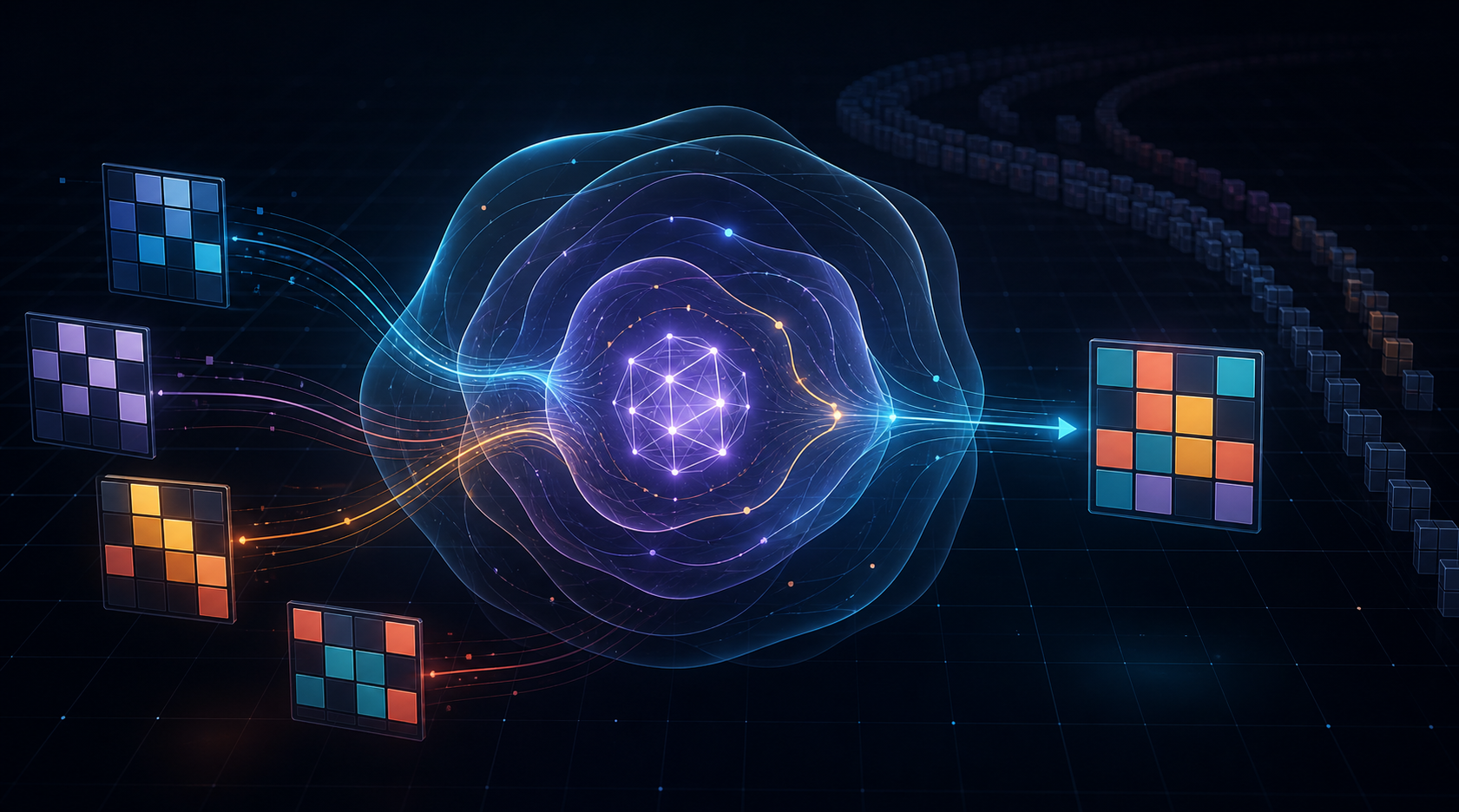
Pathway researchers have recently disclosed that a model with 150 million parameters attained a pass@2 rate of 29.5 percent on the public ARC-AGI-1 evaluation set, utilizing around 0.85 seconds of NVIDIA H200 processing time per puzzle. A recent [arXiv preprint](https://arxiv.org/abs/2608.09888) indicates that this processing duration results in an estimated inference cost of $0.00070 per task. This result is presented as a noteworthy achievement in cost efficiency rather than merely an improvement in accuracy.
The ARC Prize revealed that OpenAI’s GPT-5.6 Luna achieved a score of 34.2 percent on the same benchmark with minimal reasoning effort. Nevertheless, Pathway asserts that BDH-CQ was roughly 11 times more economical when recalibrated for Luna’s expenses following OpenAI’s price reductions in July.
ARC-AGI-1 assesses the capability to deduce rules through colored grids, providing input-output examples to ascertain transformations for new grids based on elements like counting, symmetry, and object relationships. The pass@2 standard considers a task completed if one of two submissions is wholly correct, with BDH-CQ successfully solving 118 out of 400 tasks.
The architecture of BDH-CQ incorporates latent state reasoning, contrasting with token-based systems that utilize serial scratchpads for interim calculations. Instead, it retains a consistent contextual memory and accommodates high-dimensional workspace transformations without altering parameters during assessments, thereby preserving intermediate states without requiring language decoding.
The estimated $0.00070 per task is derived from GPU time, based on an H200 rental price of $3 per hour. In comparison, calculations involving Luna necessitate adjusting a $0.040-per-task estimate from ARC Prize data, taking into account OpenAI’s price reductions, resulting in an approximate $0.008 per task. Therefore, the cost-efficiency figure for BDH-CQ is founded on calculated rather than direct service costs.
Although Luna excelled in task completion, BDH-CQ concentrates on visual ARC-style tasks, while Luna addresses a variety of modalities. The greater accuracy of the latter does not diminish BDH-CQ’s advancement in cost benefits.
The performance failure patterns seen in BDH-CQ highlight its limitations in tackling more intricate tasks. Advanced tests indicate it can integrate new mappings and expand straightforward operations but finds it challenging with deeper nesting and prolonged ordering without supplementary examples.
Upcoming tests may broaden BDH-CQ’s applicability to wider contexts such as mathematics and language reasoning, with Pathway intending further evaluations. Sharing detailed implementation and weights will be essential in determining whether these efficiency enhancements are limited to grid tasks or if they hold relevance for broader reasoning challenges.