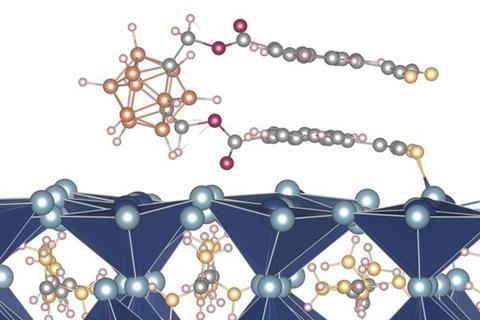
Researchers have recently introduced a novel carborane-based electron transport material intended for application in perovskite/silicon tandem solar cells, offering a promising substitute for the conventional use of buckminsterfullerene (C₆₀). For more than a decade, C₆₀ fullerenes have been the favored electron transport materials in high-efficiency perovskite and tandem solar cells due to their excellent electron mobility and straightforward deposition process. These characteristics facilitate efficient electron transfer from the light-absorbing layer to the electrode.
Nevertheless, C₆₀ fullerenes have their limitations despite their benefits. Significant interfacial non-radiative recombination losses constrain the voltage and efficiency of the devices, while unwanted light absorption reduces photocurrent. This prompted a research team spearheaded by Steve Albrecht from the Helmholtz-Zentrum Berlin and Vytautas Getautis from Kaunas University of Technology to explore alternatives.
Their work culminated in the creation of a molecule featuring a meta-carborane core along with two 9-fluorenylidene malononitrile groups. This carborane-based material can be deposited using the same thermal evaporation method applied for C₆₀, resulting in thin, uniform films. Notably, it demonstrates a more favorable interaction with the perovskite surface. Density functional theory calculations indicated that its nitrile groups productively engage with undercoordinated Pb²⁺ defects on the perovskite, aiding in efficient electron extraction and reducing interfacial non-radiative recombination losses in comparison to C₆₀.
Moreover, the broader optical bandgap of the new material lessens parasitic absorption, thereby improving light delivery to photoactive layers. This innovation enables tandem solar cells to achieve 31.3% efficiency with the new material, surpassing the 28.9% efficiency recorded with C₆₀.
As noted by perovskite chemist Michele Sessolo from the University of Valencia, this advancement is crucial as it offers a practical method for enhancing weak interfaces in these solar cells, with potential advantages for wider bandgap perovskites.
However, the main obstacle remains stability, as devices utilizing the new material showed faster degradation than those using C₆₀. The researchers speculate that the issue arises from chemical interactions at the perovskite interface rather than an inherent instability of the material. To tackle this, the team is contemplating the introduction of an interlayer between the perovskite and the carborane-based molecule, a strategy that was previously effective with C₆₀.