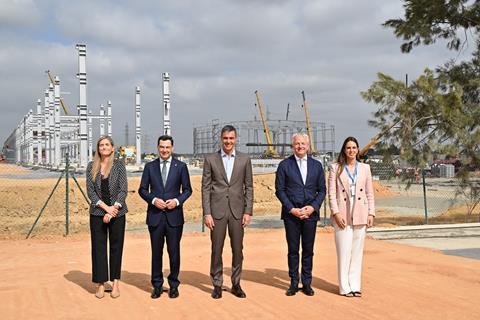
In September, the Spanish energy firm Moeve launched a major initiative by starting the construction of a 300MW solar-powered electrolyser in Huelva, situated in the southern part of Spain. The main goal is to generate CO2-emission-free ‘green’ hydrogen. This ambitious undertaking, which represents the initial phase of the Andalusian Green Hydrogen Valley, is heavily backed by the Spanish government. The government is contributing €300 million towards the overall expense, which surpasses €1 billion. Moeve intends to use the green hydrogen to substitute the fossil-based hydrogen presently utilized at the onsite refinery. Moreover, the company plans to hydrogenate waste vegetable oils to create low-emission liquid hydrocarbon fuels aimed at aviation, maritime transport, and heavy-duty road logistics, along with chemical manufacturing.
Moeve has specified its goals to expand the Andalusian Green Hydrogen Valley to a total electrolysis capacity of 2GW. This effort follows similar initiatives throughout Europe, such as in Lingen, Germany, where RWE is set to operationalize a 300GW electrolyser next year, and Stegra’s 700GW facility in Sweden which will support green iron and steel production upon commissioning.
Adrian Odenweller from the Potsdam Institute for Climate Impact Research in Germany highlighted the importance of Moeve’s endeavor. He described the initiation of such a large-scale project as ‘encouraging’, particularly for Europe. Odenweller stressed the necessity of proving the viability of hydrogen production in areas abundant in renewable resources, like the Iberian Peninsula, which is close to existing demand.
Odenweller’s research points out the existing ‘ambition gaps’ between declared intentions for green hydrogen initiatives and real progress, with many projects being shelved. The Huelva facility is anticipated to generate 45,000 tonnes of renewable hydrogen each year, which constitutes merely 0.45% of the European Union’s 2030 objective—a target that Odenweller currently views as unrealistic.
Peter Collins, a representative for Hydrogen Europe, emphasized the project’s importance in strengthening Spain and Europe’s clean hydrogen market. He acknowledged that the announcement of the project’s construction showcases the potential successes of a solid developer when aided by clear policy support and governmental endorsement.
Moeve plans to run the plant using a mix of dedicated solar power generation and electricity sourced from the grid. To meet the yearly production target of 45,000 tonnes from a 300MW electrolysis facility requires approximately 7000 hours of operation annually. This necessitates either a large solar plant with electricity storage to balance supply fluctuations or a significant electricity contribution from the grid. Odenweller noted that beginning in 2030, EU Renewable Fuel of Non-Biological Origin (RFNBO) regulations will permit hydrogen production based on grid electricity to be categorized as green if consumption is timed with the availability of renewable power.
Odenweller foresees that the demand for green hydrogen from the facility will remain focused within the local hydrogen valley area ‘for the foreseeable future’. Among the potential markets, Sustainable Aviation Fuel (SAF) stands out as particularly lucrative due to its limited availability and government regulations promoting increased usage, which enable premium pricing that offsets the higher production expenses.