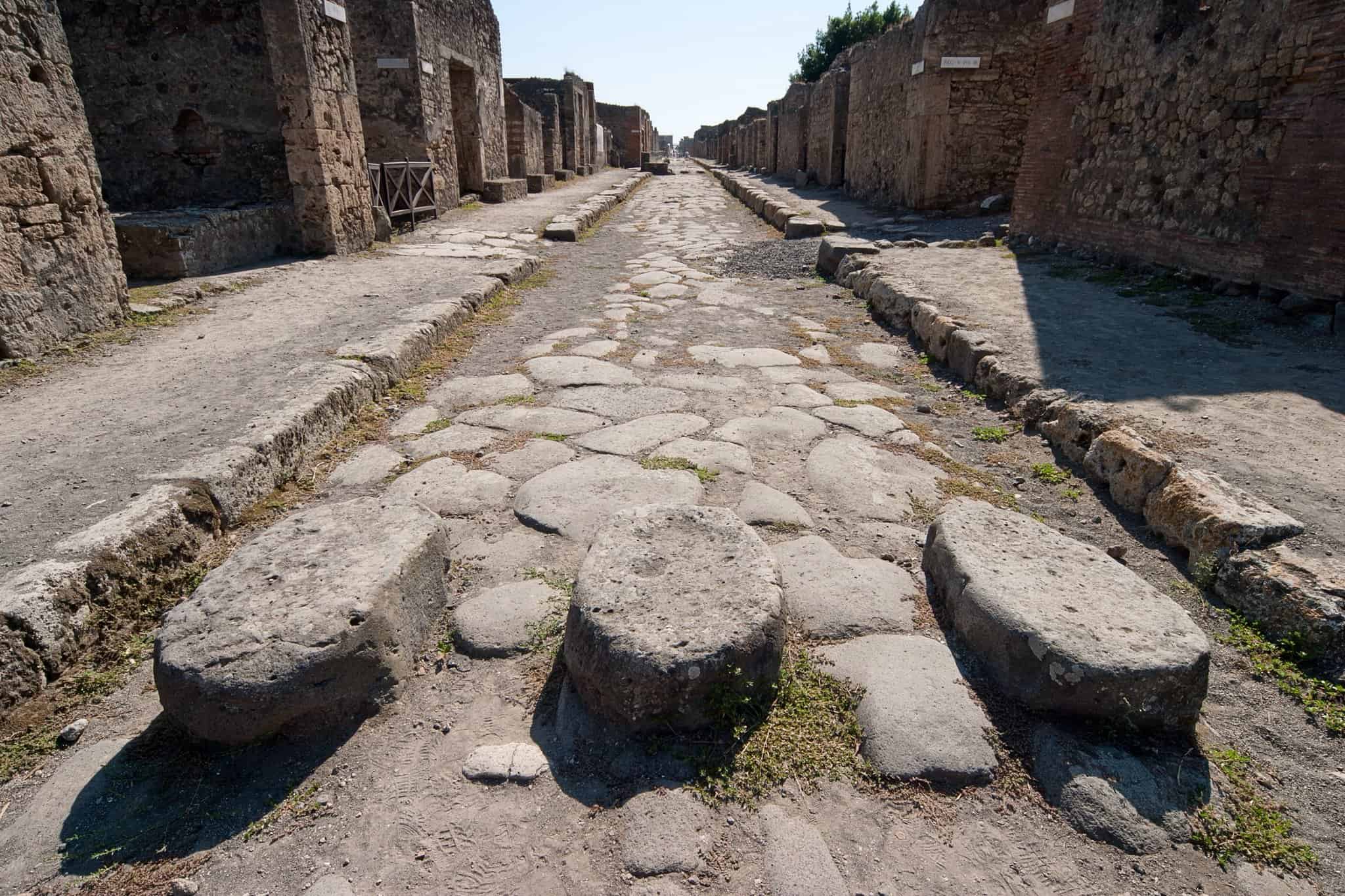
Construction materials discovered by archaeologists in Pompeii indicate that the Romans utilized ‘hot mixing’ techniques to produce concrete, according to new chemical analyses. The materials and tools were found left behind in rooms that were in the process of being built when Mount Vesuvius erupted in 79AD, obliterating the city.
‘I entered an excavation in Pompeii a year and a half ago and it felt like stepping back in time to a Roman construction environment,’ says Admir Masic, a chemist at the Massachusetts Institute of Technology who spearheaded the research. ‘There were pristine mounds of building materials remarkably preserved.’
This historical glimpse showcases efforts to repair a dwelling in Pompeii following earthquake damages, just before the disastrous eruption that entombed the Roman city. Nearby the walls being constructed were heaps of quicklime (CaO), a white substance derived from heating limestone, alongside volcanic ash packed with silica and alumina-rich minerals.
This is not an archaeology article. It’s an intriguing chemistry article
Admir Masic, Massachusetts Institute of Technology
Vitruvius, a Roman architect and engineer from the 1st century BC, documented that the production of Roman concrete began with the creation of quicklime from heated limestone, which was then mixed with water to form slaked lime (Ca(OH)2). This served as a binder when combined with volcanic ash.
However, Masic’s team is now revealing that concrete creation at Pompeii involved the separate transportation of quicklime and volcanic ash to a construction site, mixing the two dry substances, and subsequently adding water to activate an exothermic reaction that heated the mortar.
The MIT team had earlier analyzed lime clumps in ancient Roman mortars and suggested they resulted from such hot mixing, which generated hot spots in the setting concrete that could surpass 200°C. Their findings indicated that these clumps wouldn’t exist if slaked lime were utilized, supporting the idea of hot mixing as the employed method for producing these mortars. They reached this conclusion after chemically mapping the lime clasts and the adjacent matrix and examining the microstructure of Roman mortars.
This approach to concrete manufacturing offers two key advantages: it continues to improve in strength over time, and the material can set even underwater, aiding in harbor constructions, according to Masic.
The ‘lime clasts’ produced by hot mixing bestowed ancient concrete with a durability superior to modern Portland cement mortars. These clumps act as calcium reservoirs that can later dissolve and recrystallize into various calcium carbonates or react with volcanic ash to form aluminosilicates. This rejuvenates the cement-making cycle and fills minor cracks, repairing small imperfections or damages.
‘This is not an archaeology article. It’s an intriguing chemistry article,’ states Masic. ‘We even demonstrated through isotope analyses that the dry pre-mixed material is indeed quicklime.’
‘This offers a remarkable snapshot of an active construction site,’ remarks Marie Jackson, a geoscientist at the University of Utah. However, she notes that the evidence for ancient quicklime, which readily reacts with atmospheric carbon dioxide to form calcite, is not entirely evident at the site.
The Roman empire spanned a vast territory with numerous types of concrete construction, she notes. ‘Recent archaeological findings reveal many intricacies in the manufacturing and application of mortars in concrete structures along coastlines and within the sea.’
Jackson’s research has indicated that within monuments, such as Trajan’s Markets in Imperial Rome (97–115AD), varied concrete mixtures and installation techniques were intentionally utilized to improve the performance characteristics of concrete pavements, structural walls, and vaulted ceilings.
‘A claim suggesting that the Romans never slaked, or hydrated, lime in concrete construction would be incorrect,’ states Jackson. ‘Romans were extraordinarily advanced in their methods of hydrating lime and mixing mortars to fabricate concrete structures.’