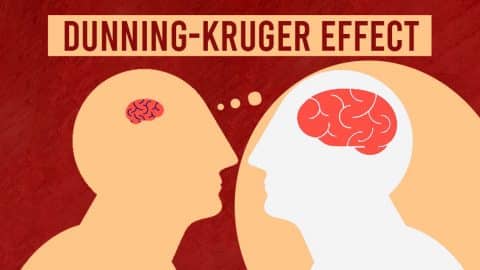
In the field of social psychology, the concept of belief superiority is receiving increasing focus. It denotes the strong conviction some people hold that their viewpoints are more valid or significant than those of others. This claim goes beyond simply asserting correctness; it includes the notion that opposing perspectives are inherently flawed. A study conducted by Michael Hall and Kaitlin Raimi, published in the Journal of Experimental Social Psychology, investigates the link between belief superiority and the propensity to overrate one’s knowledge, closely related to the well-established Dunning-Kruger effect.
The Dunning-Kruger effect explains how individuals with limited understanding in a field often overvalue their capabilities. However, belief superiority introduces an additional dimension, indicating that those who view their beliefs as superior are not only misinformed but also dismissive of contradicting evidence. This mentality may hinder individuals from acknowledging their knowledge deficits and seizing opportunities for learning. Through a collection of experiments, Hall and Raimi examine whether these individuals are genuinely more knowledgeable in the areas where they assert dominant opinions.
Their results demonstrate that belief superiority does not necessarily mean one is better informed. Instead, it frequently leads to an exaggerated sense of understanding and a decreased inclination to seek out further information or consider differing opinions. This insight underscores a more extensive psychological theme: the combination of overconfidence and the rejection of alternative viewpoints can obstruct personal and intellectual development.
This research prompts further exploration into how belief superiority affects interpersonal dynamics and communication. Gaining insight into this phenomenon is crucial, not only for academic study but also for promoting more open and informed societal conversations. As individuals and communities work towards progress, recognizing and bridging the gap between perceived and actual knowledge becomes an essential step for collective improvement.