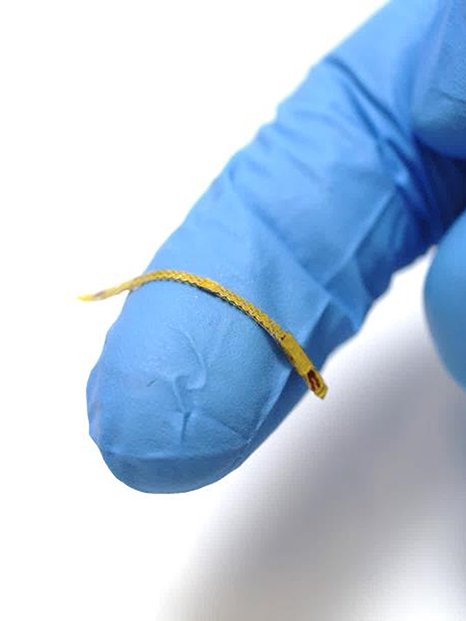
Blood pressure fluctuates throughout the day, soaring during a tense meeting, dropping during rest, and increasing during physical activity. However, most individuals with hypertension only perceive these fluctuations when they use a cuff at home or visit a doctor’s office. Now, researchers have created a device small enough to be inserted under the skin, monitoring an artery’s motion with each heartbeat, reconstructing blood pressure waveforms that rival the accuracy of intensive care observations.
The implant, detailed in *Microsystems & Nanoengineering*, utilizes ultrasound to assess how much a blood vessel expands and contracts as pressure rises and falls. In experiments with a freely moving sheep, the 5-by-5-millimeter sensor array monitored systolic pressure within 1.2 mmHg and diastolic pressure within 2.9 mmHg of a standard arterial line. The device detected features like the dicrotic notch, a small dip in the waveform indicating the closure of the heart’s aortic valve.
At its core lies a compact grid of piezoelectric micromachined ultrasonic transducers, or PMUTs. These miniature sensors produce high-frequency sound waves and listen for echoes reflecting off the front and back walls of an artery. Since blood and arterial tissue reflect sound differently, the chip can locate both surfaces. As the vessel expands with each heartbeat, the time between echoes shifts slightly. This timing variation is the signal the device converts into pressure readings.
### Importance of Subcutaneous Placement
Existing wearable ultrasound patches have been developed, but they face a persistent issue: if the sensor shifts by even a millimeter, the signal strength can decrease by 60 percent. Placing the array just beneath the skin secures it in position above the artery. In the sheep experiment, surgeons covered the chip with a 4-millimeter layer of polydimethylsiloxane, a soft, biocompatible polymer that safeguards the electronics from moisture and movement. They even rinsed the implant site with saline to eliminate air bubbles that might disrupt ultrasound transmission.
The subcutaneous method also avoids a frequent failure mode for long-lasting implants. As the body’s immune system surrounds foreign objects with tissue, many sensors lose precision. This device measures the time interval between echoes, which stays consistent even if a thin layer of tissue forms over the transducers. In practice, this means the implant could function for months or years without needing recalibration.
> “The study demonstrates that ultrasound-based implants can achieve the stability and precision necessary for continuous blood pressure monitoring without the limitations of cuffs or fragile wearables,” explains Liwei Lin.
### Ongoing Data Gathering, Silent Functionality
The sheep moved freely during the testing, enabling researchers to confirm the system’s operation in realistic conditions rather than on a sedated animal secured to a table. The implant obtained clear waveforms that corresponded to the arterial line’s readings over multiple sessions. Because it operates silently, the device could eventually aid doctors in identifying dangerous spikes that happen during sleep or physical exertion, times when patients seldom check their blood pressure.
The team noted that additional trials are essential before the technology is applied to humans, but the sheep data indicate that clinical-grade accuracy is possible. If the implant proves successful, it could provide clinicians with hourly insights on the effectiveness of medications, uncover patterns that regular cuff readings overlook, and assist patients in understanding their cardiovascular activity when not monitored. For now, the device serves as proof of concept: blood pressure monitoring can be continuous, precise, and nearly imperceptible.
[Microsystems & Nanoengineering: 10.1038/s41378-025-01019-w](https://doi.org/10.1038/s41378-025-01019-w)
**No paywall here**
*If our coverage has enlightened or inspired you, please consider making a contribution. Every donation, regardless of amount, enables us to continue providing accurate, engaging, and reliable science and medical news. Independent journalism demands time, effort, and resources—your support ensures we can keep revealing the stories that matter most to you.*
Join us in making knowledge accessible and impactful. Thank you for supporting us!