Psychologists have been assessing reaction times since before the establishment of psychology as a formal scientific field. In contemporary research, reaction times continue to be an essential method in cognitive psychology studies. These investigations often examine differences in the duration it takes for participants to react to stimuli under varying conditions to reveal disparities in cognitive processing.
The origins of reaction time measurement date back to the late 19th century when Francis Galton, a significant figure renowned for his input in eugenics and statistics, initiated the collection of extensive data on what is referred to as ‘simple reaction times’ (Galton’s dataset included 3,410 samples). Galton’s main focus diverged from modern psychological investigation; he theorized that reaction times could be indicative of personal differences, especially in intelligence. He suggested that variations in processing speeds might be behind inequalities in intelligence, implying that reaction times could offer a rapid evaluation of cognitive ability.
Galton’s vast dataset presents a distinctive opportunity for evaluation: are individuals today, over a century later, quicker or slower than his Victorian subjects? Based on Galton’s theory, this evaluation could provide insights pertinent not only to speed-based contests but also into wider generational transitions in cognitive capacity.
Data on reaction time offers a captivating context when examined alongside the much-discussed Flynn Effect, which records a generational increase in IQ scores. The Flynn Effect confronts two groups: those who intuitively believe that “kids these days” are inferior compared to earlier generations, a sentiment held throughout history, and those who contend that the current population should be less intelligent due to a decline in birth rates among more intellectually capable individuals.
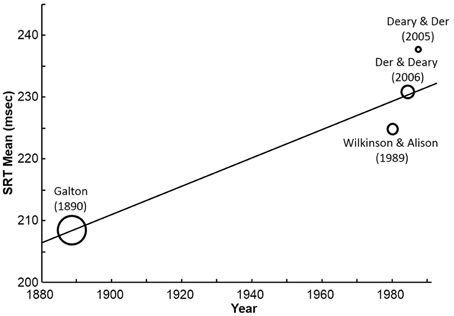
While the Flynn Effect suggests an increase in IQ, reaction time data introduces a compelling contradiction. Some research indicates that Victorians had faster reaction times, suggesting they might have been more cognitively proficient. Efforts to compare Galton’s results with contemporary studies have been made, striving to replicate his original methodologies and instruments. Silverman (2010) pointed out that, with the exception of a single instance, studies after 1941 have recorded longer reaction times than those reported by Galton. While there may be concerns regarding instrument accuracy, these variations are generally viewed as unlikely to be attributable to measurement inaccuracies.
A telling graph by Woodley et al. (2015) illustrates a slight, yet noteworthy, gradual deceleration of reaction times over the past century in the UK. Although the difference is only about ~20 milliseconds over 100 years — approximately a tenth slower than during the Victorian period — this alteration is significant in reaction time research, representing roughly a 10% slowdown.
Interpreting this information presents difficulties. Does it reflect a true decrease in cognitive processing speed? Or might there be other elements influencing this trend, such as heightened cognitive demands in other areas, shifts in motivation, or changes in participants’ experimental approaches? While additional research is required to formulate definitive conclusions, current findings imply that present generations may indeed exhibit slower reaction times compared to their Victorian predecessors. This provokes discussion and calls for further exploration to comprehend the intricacies of cognitive development over time.
References:
– Irwin, W. S. (2010). Simple reaction time: it is not what it used to be. American Journal of Psychology, 123(1), 39-50.
– Woodley, M. A., Te Nijenhuis, J., & Murphy, R. (2013). Were the Victorians cleverer than us? The decline in general intelligence estimated from a meta-analysis of the slowing of simple reaction time. Intelligence, 41(6), 843-850.
– Woodley, M. A., te Nijenhuis, J., & Murphy, R. (2015). The Victorians were still faster than us. Commentary: Factors influencing the latency of simple reaction time. Frontiers in Human Neuroscience, 9, 452.