**Utilizing Bourbon Byproducts: University of Kentucky’s Innovation in Energy Storage**
An innovative initiative at the University of Kentucky has revealed new possibilities for a waste product that many have neglected: bourbon distillation byproducts. A research group headed by environmental chemist Marcelo Guzman has transformed the residual waste from the bourbon distillation process into electrodes for supercapacitors, highlighting a promising pathway for eco-friendly energy storage. They shared their results on March 24th during the American Chemical Society’s conference in Atlanta, Georgia.
The endeavor, started in the summer of 2000, utilizes hydrothermal carbonization to convert distillery waste into valuable carbon materials. This method heats biomass in a liquid solution under high temperatures and pressures, yielding activated carbon suitable for energy storage devices. Josiel Barrios Cossio, a PhD student who joined the team in 2021 from Cuba, clarifies that the unique conditions present in hydrothermal carbonization promote the conversion into carbon materials.
For testing purposes, the researchers fabricated double-layer capacitors featuring bourbon waste-derived activated carbon electrodes, containing a liquid electrolyte. Preliminary evaluations indicated these coin-sized supercapacitors could attain energy storage of up to 48 watt-hours per kilogram—a performance capability comparable to current commercial supercapacitors.
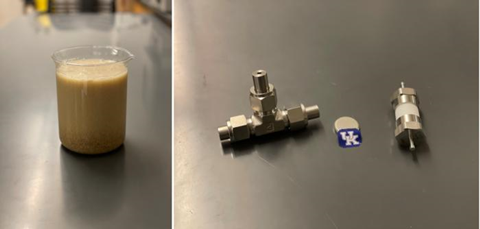
The bourbon creation process begins with a mix of grains—51% of which must consist of corn—to qualify as bourbon whiskey. After fermentation and distillation, the process produces a byproduct called stillage, a liquid containing approximately 10% solids. With Kentucky’s significant expansion in the bourbon sector—growing from 19 distilleries in 2010 to 125 in 2023—the thriving industry faces a challenge with an abundance of stillage, often sold as animal feed or a soil additive.
Guzman’s team partners with local distilleries to implement hydrothermal carbonization on this surplus stillage, resulting in activated carbon with a porous structure perfect for electrodes. Collaborating with Friedrich Schiller University in Germany, they also created hybrid lithium-ion supercapacitors, incorporating these bourbon-based materials. This advancement demonstrated energy storage capacities ranging from five to 25 times greater than conventional models.
With no prior examples of bourbon stillage conversion, Cossio envisions extensive applications not only for the whiskey sector but also for breweries and ethanol manufacturers throughout the U.S. The team is actively seeking to broaden partnerships with regional distilleries to enhance the applicability of their innovation.
Guzman’s group intends to further explore the energy storage potential of their supercapacitors, aiming to scale them for commercial markets. They plan to perform life cycle, economic, and technological feasibility assessments to evaluate the sustainability of this concept. As Cossio emphasizes, waste management is crucial for industry advancement and sustainability, making this development not just timely but essential for future environmental and economic well-being.