Reaction times have persistently served as a significant metric in the field of psychology, valued for their ability to illuminate cognitive mechanisms. Since the emergence of psychology as a separate scientific domain, researchers have diligently recorded reaction times as a parameter of cognitive processing speed—an approach that continues to play a crucial role in numerous cognitive psychology studies. By investigating variations in reaction times across different conditions, psychologists aim to unravel the fundamental differences in cognitive operation.
The distinguished lineage of reaction time investigation traces back to Francis Galton, a prominent statistician and eugenicist. In the late 19th century, Galton compiled a substantial dataset consisting of 3,410 individual reaction times. His pioneering endeavors somewhat deviated from the emphasis prevalent among contemporary psychologists; Galton viewed reaction times as markers of individual variability and theorized that processing speed might indicate intelligence. He proposed that through careful measurement of reaction times, one could gain insights into cognitive abilities.
An intriguing inquiry emerges from Galton’s dataset, bridging the historical context to present-day: Are modern individuals faster or slower in reaction than Galton’s Victorian subjects? If Galton’s hypothesis is valid, this query may reveal more than just historical interests; it might also highlight significant generational changes in cognitive abilities.
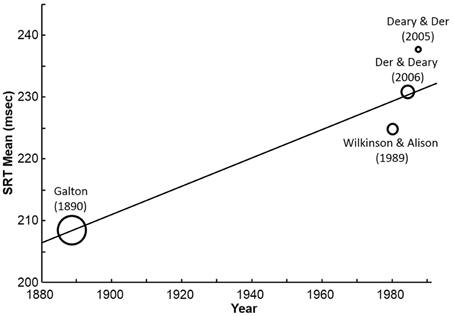
Reaction time statistics present a compelling contrast to the widely recognized Flynn Effect, a phenomenon noted for a generational rise in IQ scores. While detractors and naysayers might be surprised by this upward trajectory in intelligence, reaction time statistics provide reassurance to those who nostalgically cherish the youth of earlier times compared to current generations. Is it possible that individuals in the Victorian era had quicker reaction times? Various studies have meticulously compared Galton’s findings with present-day results, some replicating Galton’s methodologies and equipment in detail. Research, including that of Silverman (2010), indicates that reaction times have indeed lengthened since Galton’s time, suggesting that this change cannot be solely attributed to methodological inconsistencies.
Visual representations of reaction time findings, such as those by Woodley et al. (2015), highlight a modest yet significant change of roughly 20 milliseconds—a considerable span in the context of reaction time, indicating that modern subjects might be approximately 10% slower.
What, then, can we deduce from this fascinating temporal alteration? Even though a single study, regardless of the number of participants involved, might lack definitive significance, the absence of intermediate research complicates efforts to validate or dispute the findings. The consequences extend beyond surface-level reflections on generational intelligence. One must consider whether this signals a real decline in cognitive ability, merely reflects changed experimental settings, or mirrors shifts in motivation and engagement among the participants.
In spite of the persuasive evidence, interpretative caution is crucial. Addressing these complex questions requires an integration of additional research, historical juxtaposition, and subtle interpretation. The endeavor to uncover the realities embedded in reaction time continues, compelling us to reconsider the evolution of generational intellect.
References:
- Irwin, W. S. (2010). Simple reaction time: it is not what it used to be. American Journal of Psychology, 123(1), 39-50.
- Woodley, M. A., Te Nijenhuis, J., & Murphy, R. (2013). Were the Victorians cleverer than us? The decline in general intelligence estimated from a meta-analysis of the slowing of simple reaction time. Intelligence, 41(6), 843-850.
- Woodley, M. A, te Nijenhuis, J., & Murphy, R. (2015). The Victorians were still faster than us. Commentary: Factors influencing the latency of simple reaction time. Frontiers in human neuroscience, 9, 452.