Selecting the appropriate materials for reactors is essential in the chemical industry to avert expensive and perilous repercussions. Incompatibility of materials can unexpectedly emerge from new chemical interactions as the field of chemistry progresses. Eric Margelefsky and his team at Merck & Co have released a handbook on evaluating materials compatibility to reduce such hazards.
Margelefsky points out the unpredictability of material behavior, mentioning cases where a chemically inert solvent and an acid, when mixed, lead to metal corrosion. Within shared-use facilities that are commonplace in small-molecule pharmaceutical ingredient manufacturing, it is vital to evaluate the effect of the proposed chemistry on the materials of existing reactors.
Choosing new equipment requires a balance between cost and chemical resistance. Materials with high resistance typically come at a greater cost, making selection about materials also a business consideration.
Material incompatibility can result in catastrophic industrial failures, as corroded metal can weaken and increase the likelihood of unforeseen failures, release of flammable gases, explosions, and fires. Metal ions released from corrosion can disrupt pharmaceutical operations, as Merck learned when transition metal ions influenced chiral hydrogenation and iron changed product color.
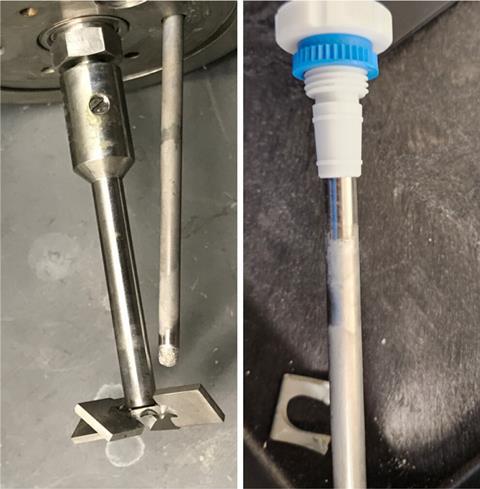
Merck employs immersion and electrochemical corrosion testing to assess metal corrosion. Immersion testing entails suspending a metal coupon in a solution, frequently heated or agitated, to determine corrosion rates. Electrochemical testing, while more rapid, requires aqueous solutions and gauges corrosion by measuring electronic flow from the metal to the solution.
For polymer compatibility, analogous immersion tests are conducted, along with further hardness evaluations under wet and vacuum-dried conditions. UV exposure is a significant factor for polymer equipment stored outdoors.
Glass equipment also undergoes immersion studies, as any changes can compromise its cleanliness, leading to contamination or additional corrosion. Static discharge is yet another issue, causing glass-lined vessels to develop pinholes, which pose ignition risks if not sufficiently inert.
Bench chemists, including those from smaller firms, can benefit from Merck’s methodical and quantitative methodology despite limitations in resources. Margelefsky recommends remaining alert to material-reactor incompatibility and watching for signs of corrosion, especially prior to scaling up, to prevent costly damage.