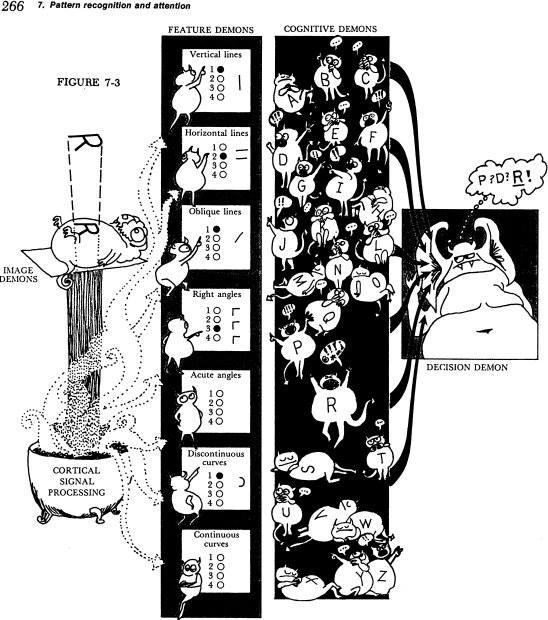
Oliver Selfridge, a pioneer in the realm of artificial intelligence, made profound contributions to cognitive computing with his groundbreaking idea of ‘pandemonium architecture’ in 1959. This framework, detailed in his seminal paper, suggested a structure of basic units, each assigned a specific role, linked together to perform intricate cognitive functions. This methodology established the foundation for subsequent advancements in neural networks, which have become fundamental components of contemporary machine learning technologies today.
Selfridge’s Pandemonium model achieved fame in part due to enchanting illustrations by Leanne Hinton in the 1977 psychology textbook ‘Human Information Processing’ by Lindsey & Norman. While these illustrations were characterized by some as resembling “the expressions of a child’s nightmare,” others found them charming, with their playful portrayal of friendly demons. Despite the broad acknowledgment of the Pandemonium model, Hinton’s contributions frequently go unrecognized.
In addition to his theoretical contributions, Selfridge wrote four children’s books and was instrumental in revealing the NSA’s Echelon surveillance program. Despite attempts to gather more information from Hinton regarding her illustrations, definitive verification of her involvement remains elusive. If anyone possesses further details or corrections related to Selfridge’s work or the illustrations, they are encouraged to get in touch.