**Reaction Times: An Exploration Through Time**
Psychologists have been intrigued by reaction times (RT) since well before psychology was established as a formal discipline. Reaction times remain a fundamental component in contemporary cognitive psychology research. Investigators frequently explore variations in the duration it takes for participants to react to stimuli under differing conditions to uncover insights into the cognitive mechanisms involved in these scenarios.
The eminent statistician and eugenicist, Francis Galton, compiled an extensive dataset of ‘simple reaction times’ during the late 19th century. Galton’s interests diverged from those of modern psychologists—he regarded reaction time as a measure of individual differences, proposing that disparities in processing speed could be indicative of variations in intelligence. He thought that these differences might be effectively evaluated through the observation of reaction times.
A captivating question emerges from Galton’s findings: Are modern individuals quicker or slower than Galton’s Victorian participants? If one follows Galton’s hypothesis, the answer could inform not only our ability to compete in speed contests with a Victorian peer but also shed light on generational changes in cognitive abilities.
Data on reaction times presents a compelling contrast to the Flynn Effect, which describes the rise in IQ scores from one generation to the next. This phenomenon puzzles two camps—those who perceive “today’s youth” as less disciplined and intelligent than their own generation (a sentiment recorded since ancient times) and those who, based on theoretical assumptions, anticipate declines in intelligence across generations.
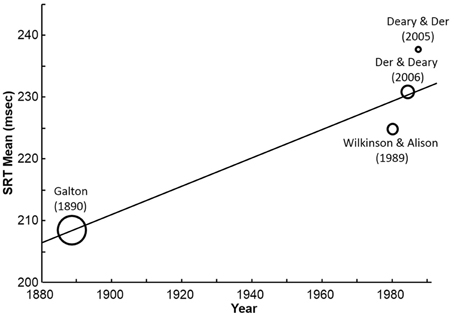
While the Flynn Effect questions the idea of diminishing intelligence, reaction time data offers an opposing viewpoint. Numerous studies have reexamined Galton’s results, juxtaposing them with current findings, often utilizing similar tools and methodologies. Silverman (2010) determined that, with few exceptions, contemporary studies exhibit longer RTs compared to Galton’s initial ones, ruling out the possibility that discrepancies stemmed from inaccurate timing devices.
Recent investigations by Woodley et al. illustrate a graph showcasing a gradual deceleration in RT over a century, revealing that modern participants are approximately 10% slower than their Victorian counterparts.
Interpreting this information raises additional questions. Is this truly an indication of a decline in cognitive ability? Or could it signify heightened cognitive demands, motivational changes, or alterations in experimental techniques? Nonetheless, a definitive interpretation continues to be elusive.
**References:**
– Irwin, W. S. (2010). *Simple reaction time: it is not what it used to be*. American Journal of Psychology, 123(1), 39-50.
– Woodley, M. A., Te Nijenhuis, J., & Murphy, R. (2013). *Were the Victorians cleverer than us? The decline in general intelligence estimated from a meta-analysis of the slowing of simple reaction time*. Intelligence, 41(6), 843-850.
– Woodley, M. A, te Nijenhuis, J., & Murphy, R. (2015). *The Victorians were still faster than us. Commentary: Factors influencing the latency of simple reaction time*. Frontiers in human neuroscience, 9, 452.