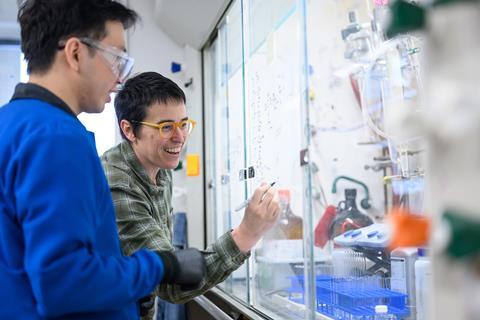
Alison Wendlandt is a chemist whose research merges two cutting-edge domains of chemical reactions: stereochemical modification and contra-thermodynamic processes. Her studies involve manipulating molecular stereochemistry, primarily through reactions that alter the chirality of chiral centers, resulting in products with higher energy levels compared to their more stable counterparts. Wendlandt characterizes her work as a complementary synthetic strategy, concentrating on fine-tuning the stereochemistry of molecules during later stages of synthesis, in contrast to conventional methods that establish 3D geometry from the outset.
Wendlandt primarily employs photocatalysis, where light-activated catalysts enable reactions to reverse stereochemistry. This methodology facilitates the creation of challenging molecules, such as the sugar d-allose, by modifying the configuration of chiral centers. While these processes might result in lower yields, they can considerably decrease the number of synthesis steps. Her team also confronts the task of isolating closely related isomers, developing techniques utilizing modified silica gels to achieve this.
The exploration of reaction mechanisms in Wendlandt’s research necessitates sophisticated techniques due to the difficulties in observing light-driven reactions. Innovative technologies like transient absorption spectrometry and partnerships for computational analysis assist in uncovering insights into reaction dynamics. Wendlandt’s goal is to engineer catalysts that enhance selectivity and efficiency, emphasizing the significance of contra-thermodynamic editing as a groundbreaking strategy in the field of chemistry.