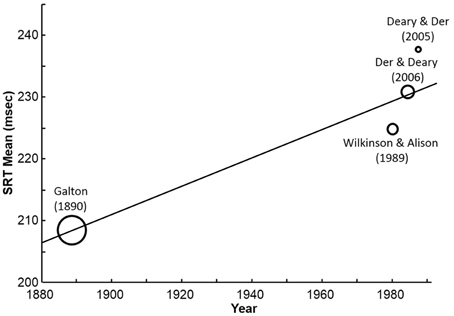
Psychologists have historically utilized reaction times as a key metric in cognitive psychology studies. Monitoring how swiftly individuals react to stimuli in various contexts yields insights into differences in cognitive processing. This tradition predates the formal inception of psychology, originating from the efforts of Francis Galton in the 19th century. Galton, recognized for his contributions to statistics and his controversial interests in eugenics, compiled a considerable dataset of simple reaction times from 3,410 subjects. His objective was to investigate reaction time as a possible measure of intelligence, proposing that quicker processing speed was linked to higher intelligence.
Galton’s dataset presents a distinctive chance to contrast the cognitive functions of past and present individuals. Investigating whether contemporary people have quicker reaction times than those from the Victorian era may provide revelations about generational cognitive changes, mirroring the well-established Flynn Effect, which notes an increase in IQ scores across generations. In spite of the belief that newer generations are less intelligent, some scholars suggest that reaction time evidence might indicate the opposite.
Research contrasting Galton’s results with modern findings reveals an intriguing pattern – today’s reaction times seem to be slower, by approximately 20 milliseconds over a century. Examination of 14 studies conducted from 1941 onward uncovers longer reaction times in comparison to those recorded by Galton, resulting in an estimated 10% slowdown. This temporal variation prompts inquiries: does it imply a deterioration in cognitive abilities, a transformation in cognitive priorities, or shifts in experimental techniques?
The importance of these outcomes is still under discussion, complicated by the scarcity of longitudinal studies. While one might expect a gradual evolution in reaction times from the Victorian period to the present, data from intermediary stages is limited. Possible interpretations span from a real cognitive decline to heightened cognitive demands or motivational changes in participants. As this dialogue progresses, it is evident that comprehending the intricacies of reaction time necessitates deeper investigation beyond a sole historical comparison. As it is, these revelations instigate ongoing reevaluation of the beliefs and methods employed to assess cognitive progression across generations.
**References:**
– Irwin, W. S. (2010). Simple reaction time: it is not what it used to be. *American Journal of Psychology, 123*(1), 39-50.
– Woodley, M. A., Te Nijenhuis, J., & Murphy, R. (2013). Were the Victorians cleverer than us? The decline in general intelligence estimated from a meta-analysis of the slowing of simple reaction time. *Intelligence, 41*(6), 843-850.
– Woodley, M. A, te Nijenhuis, J., & Murphy, R. (2015). The Victorians were still faster than us. Commentary: Factors influencing the latency of simple reaction time. *Frontiers in human neuroscience, 9*, 452.