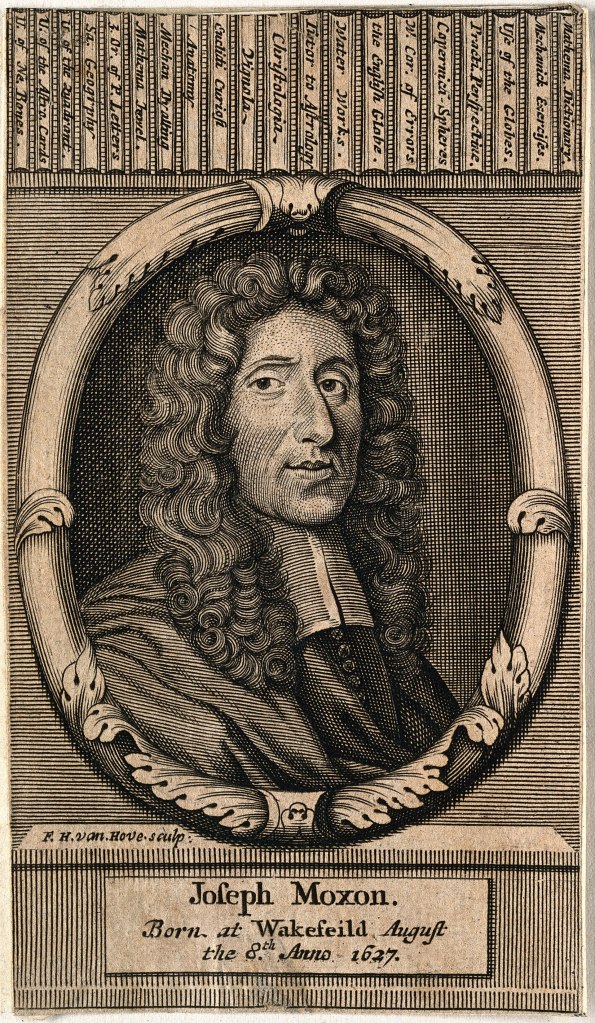
Emery Molyneux and Joseph Moxon: Connecting Mathematics and Cartography in Early Modern England
Within the sphere of early modern cartography and mathematics, the impact of Emery Molyneux and Joseph Moxon is significant, serving as a conduit of knowledge between England and the Netherlands. Molyneux, celebrated as England’s inaugural printed-globe maker, established a basis that would lie dormant until Joseph Moxon, sixty years thereafter.
Molyneux’s globes, crafted with the engraving talent of Flemish craftsman Jodocus Hondius, were a result of international collaboration during a time when religious strife prompted many artisans, including Hondius, to relocate. Similarly, the Moxon family undertook a journey from England to the Netherlands under religious duress. Joseph Moxon, born in Wakefield, sought education in practical mathematics in Amsterdam, gaining expertise that would later rejuvenate globe-making in England.
After returning to London post-1646, Moxon established a considerable trade in globes, maps, and paper instruments — these serving as affordable alternatives to their metal versions. His endeavors included scientific expositions and technical manuals, with A Tutor to Astronomy and Geography marking his debut as an author in 1654. Throughout his lifetime, Moxon published more than thirty volumes that widely distributed mathematical knowledge.
Moxon’s appeal to Charles II, leading to his designation as Hydrographer to the King, reflects his prominence in the mathematical community, supported by individuals pivotal in the formation of the Royal Society. Elected as the first tradesman fellow of the Royal Society in 1678, Moxon remained actively involved until the society designated another printer in 1680.
In addition to his respected publications, Moxon’s efforts in pocket globes enhanced the educational realm. The Mechanick Exercises disclosed trade secrets to a wider audience, signifying a transition towards openness in practical knowledge. His Mathematical Dictionary, another pioneering work in mathematical literature, encompassed astrology, further exemplifying the era’s comprehensive scientific outlook.
Moxon’s affiliations with prominent figures such as Robert Hooke and Edmond Halley highlight his crucial part in nurturing a scientific community. Despite a historical narrative dominated by illustrious names and discoveries, Moxon’s influence persists as a unifying force in the early scientific community, echoing through numerous editions of his works that continue to be relevant today.