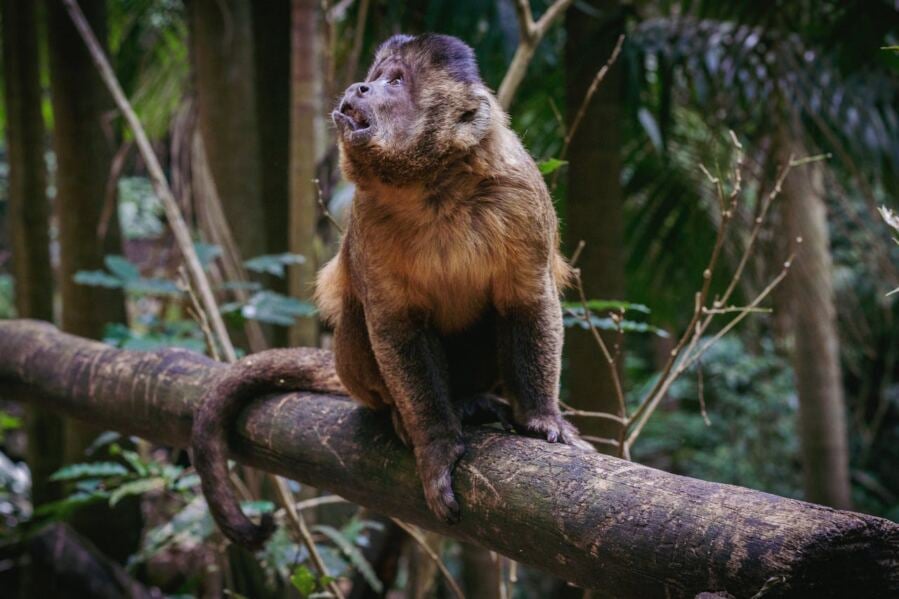
By January, the rivers in Costa Rica’s Guanacaste province have dwindled to mere threads. The tropical dry forest, which appeared improbably vibrant just weeks earlier, begins to shed leaves in handfuls, and the shade that made it passable during the wet months starts to vanish overhead. For the white-faced capuchin monkeys navigating this terrain, the timing is critical. A researcher equipped with a GPS device attached to her backpack closely trails, documenting sleeping sites, tallying fruit bites, and monitoring the direction in which the group moves when encountering neighbors. She has been engaged in this work, more or less, since 1990.
Susan Perry, an anthropologist at UCLA who has headed the Lomas Barbudal Monkey Project in Costa Rica for 35 years, has amassed something truly unique: a longitudinal record of 12 adjacent capuchin groups spanning three decades, complete with demographic surveys, satellite images, and sufficient behavioral data to begin addressing questions that shorter studies simply cannot explore.
The inquiry she and her colleagues at Germany’s Max Planck Institute of Animal Behavior aimed to resolve, published this week in *Nature Ecology and Evolution*, is deceptively straightforward. Is it advantageous to be part of a large group or a small one? The answer, it turns out, hinges almost entirely on the recent weather conditions.
## The Arithmetic of Group Living
Every capuchin group grapples with a version of the same dilemma. More individuals mean more allies in territorial conflicts, more eyes looking out for predators, and more strength when a neighboring group encroaches too closely. However, having more individuals also results in more mouths consuming from the same set of fruiting trees, which depletes those areas more quickly and compels everyone to travel further to secure food. Ecologists refer to the first challenge as scramble competition: not direct confrontation, just the collective exhaustion of shared resources. For decades, the prevailing assumption has been that larger groups should cover greater distances each day to compensate. Perry’s data presents a different narrative.
“It appears that larger groups offset the increased number of mouths to feed not by travelling farther each day, but by having access to a wider variety of resources they can utilize, which enables them to explore less depleted food patches,” Perry noted.
The mechanism, upon examination of the data, is territorial expansion rather than prolonged daily treks. Larger groups gradually extend their territories outward, claiming areas from smaller groups. In the dataset, which monitored 335 individually identified monkeys through over 900 dyadic group comparisons, the trend was clear: when a neighboring group increased in size relative to a focal group, it encroached on that group’s territory. In 84% of cases where overlap increased significantly, it was the relatively larger group that was doing the encroaching. Essentially, smaller groups were squeezed.
## Dry Season: The Pressure Builds
The dry season complicates matters politically. As water and food become concentrated along the rivers, every group is pushed towards the same stretches of evergreen riparian forest. Home range overlap between groups actually diminishes during the dry months (they’re competing for the prime patches rather than casually sharing them), yet encounter rates rise. Groups encounter each other more frequently per unit of shared space compared to the wet season. Larger groups often occupy the highest-quality areas along the riverside; smaller groups get relegated to the less favorable parts of the forest. It appears that direct resource defense becomes the key strategy precisely when there is something to protect.
The data collected over 33 years revealed insights that shorter studies could not. It illustrates how this seasonal arithmetic is disrupted by El Niño and La Niña. Both climatic cycles, which periodically induce extremes in Guanacaste’s weather, intensified within-group competition for larger groups. An exceptionally dry dry season, or an unusually soaked wet one, significantly aggravated the foraging disadvantage associated with being large. “Long-term datasets like this one are scientifically invaluable, making the hardships feel worthwhile,” Perry stated. The challenges are tangible: a 12 or 13-hour day trailing monkeys through difficult environments, year after year, to capture conditions that may occur just once every decade.
Interestingly, intermediate anomalies told a different tale. When climatic conditions partly counterbalanced the typical seasonal trend (a wet season that was drier than usual, or a dry season with unexpected rainfall), the foraging penalty for large groups largely disappeared, and their territorial advantage over smaller neighbors appeared to strengthen. The researchers hypothesize that intermediate climate fluctuations might enhance the variability in habitat quality in ways that larger groups, with their numerical strength, can exploit more effectively than smaller groups can.
## A Buffer That Has Limits
The findings outline a vision of capuchin social structure as more dynamic than a fixed ideal. Large groups absorb the costs of internal competition partially by driving smaller neighbors away from more favorable foraging territories. Smaller groups survive by minimizing their internal competition burden, remaining close to their core areas, and taking advantage of the gaps left by larger groups.