A phonon is incredibly tiny. It represents the quantum of vibrational energy, the absolute minimum of sound, devoid of mass and existing only momentarily before blending back into the thermal noise of its surrounding material. For quantum engineers aiming to create the next generation of computing technology, this fleeting nature has long posed a challenge. Constructing an information highway from something that scarcely exists is impossible. Yet, a team at Harvard has recently shown that a single phonon, a lone packet of vibration resonating through a meticulously crafted diamond, can penetrate an atomic defect and alter its quantum state. The ramifications extend well beyond the elegant physics involved.
The findings, published in Nature, represent the inaugural observation of what physicists refer to as the acoustic Purcell effect at the single spin qubit level, marking a significant milestone in a field that has been striving to reach this point for nearly a decade.
To grasp the significance, it’s beneficial to consider the challenges facing quantum engineers. The most advanced quantum processors today, whether constructed from superconducting circuits or utilizing atomic defects in crystals, tend to excel in isolation yet perform poorly in interaction. Transferring quantum information from one type of qubit to another is akin to having two musicians playing in different keys attempting to improvise together without a common instrument. Light has been the obvious candidate for bridging this gap, but it has its complexities: it is difficult to harness, easily lost, and not every qubit interacts with it seamlessly. Surprisingly, sound may provide a more effective solution.
Marko Loncar, who heads the Harvard group, stated it plainly: “At the essence of the experiment is a phonon, the tiniest unit of sound. When we listen to music, it requires countless phonons collaborating to vibrate our eardrums and may even get us moving on the dance floor. However, qubits are much more sensitive: a single phonon can suffice to alter their quantum state, energize them, or, as our experiment showed, assist them in relaxing.”
A Diamond Microphone for a Single Atom
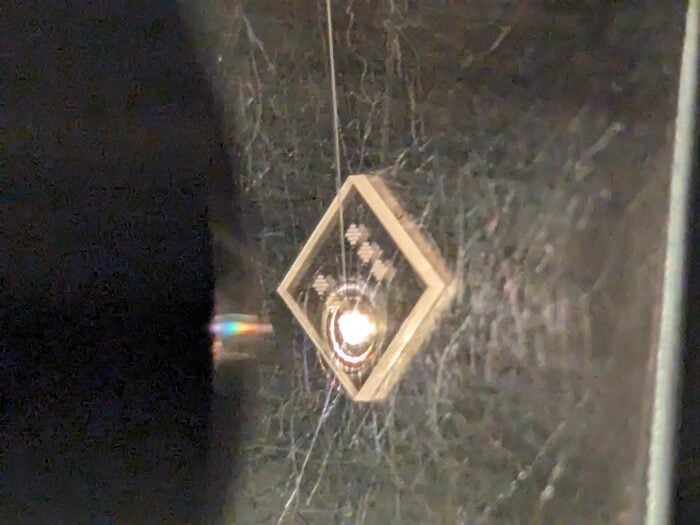
The device constructed by Loncar’s team is undeniably a remarkable feat of engineering. They fashioned a diamond waveguide into an optomechanical crystal featuring a design of eye-shaped holes, implanting a single silicon-vacancy center (a defect where two neighboring carbon atoms in the lattice are substituted by a silicon atom and a vacancy) at precisely the optimal spot to detect the mechanical oscillation of the structure. The entirety of the setup was cooled to about 44 millikelvin, just above absolute zero. At this temperature, the device’s 12-gigahertz mechanical mode contained less than one-fiftieth of a phonon on average, residing nearly in its quantum ground state.
What the researchers subsequently observed was the acoustic equivalent of an effect first predicted by Edward Purcell in 1946 for electromagnetic cavities: that a resonator configured correctly around an emitter can significantly modify the rate at which that emitter releases energy. By tuning the spin qubit’s frequency to resonate with the mechanical breathing mode through adjustments in an external magnetic field, the qubit’s relaxation rate surged tenfold. In other words, the phonon was performing precisely as they had theorized and designed it to.
The Numbers That Matter
This tenfold amplification is the prominent figure, yet the more crucial metric is the cooperativity, which indicates whether a quantum system is genuinely exchanging information coherently with its environment or merely dissipating energy into it. The Harvard device achieved a T1-based cooperativity of approximately 10, the highest spin-phonon cooperativity documented to date, to the authors’ knowledge. It still falls short of what most practical applications demand, partly because the material deposited during cavity tuning introduced undesirable mechanical damping. However, Loncar’s team estimates that switching to electrostatic tuning methods could enhance the cooperativity by two orders of magnitude, positioning the system comfortably within the range needed for true quantum-coherent interconnects.
Graham Joe, the paper’s first author and a former Harvard graduate student who contributed to designing and conducting the experiments, is forthright about why phonons warrant this level of dedication. “Numerous quantum systems, comprising superconducting qubits, quantum dots, or solid-state defects, are known to interact…