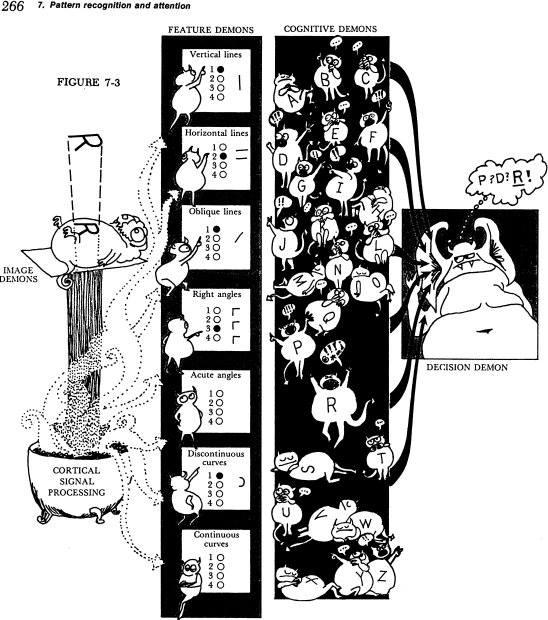
Oliver Selfridge was a key player in the foundational stages of artificial intelligence. In 1959, he unveiled the “Pandemonium architecture,” an innovative idea within the field of cognitive tasks and neural networks. This framework suggested that intricate tasks could be decomposed and managed by interconnected basic units, each executing a specific role. His concepts laid the groundwork for contemporary machine learning and have profoundly shaped current research in neural networks.
The Pandemonium model gained visual notoriety through illustrations by Leanne Hinton, featured in the 1977 psychology textbook “Human Information Processing” by Lindsey & Norman. These visuals were compared to child-like nightmares for their depiction of the intricate dynamics of Parallel Distributed Processing, yet are also viewed as charming.
Beyond his AI contributions, Selfridge was an author of children’s literature, experienced three marriages, and was active in revealing details about the National Security Agency’s Echelon program. Despite the widespread recognition of the Pandemonium model, Leanne Hinton, the artist, frequently remains unacknowledged. Attempts to confirm her involvement in these illustrations have been fruitless, despite a possible connection to Professor Emerita Leanne Hinton from the University of California, Berkeley. Her response was unattainable, and permission to publish the illustrations was not granted.
For any further details or amendments, please get in touch.