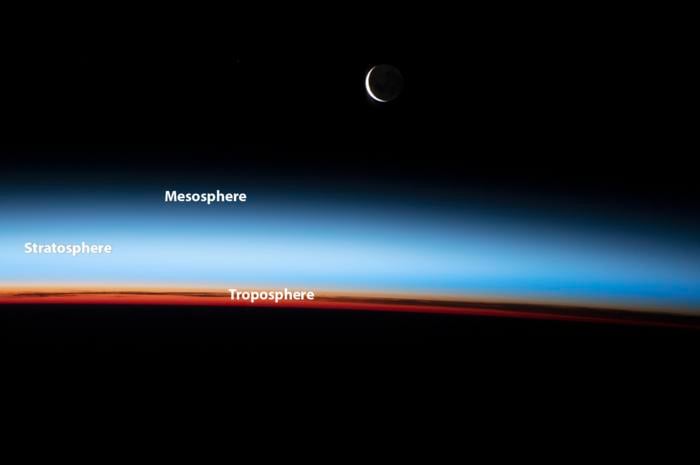
There exists a genuinely peculiar aspect regarding the upper atmosphere. While the surface of the Earth endures intense heat, the stratosphere has been experiencing a decline in temperature, decreasing by approximately two degrees Celsius since the mid-1980s. This figure is rather understated; models indicate that without human CO2 emissions, the cooling would have been perhaps a mere tenth of that. The gas that warms the planet below is functioning more like a refrigerator at elevated altitudes. Scientists have recognized this phenomenon for decades. What remained unexplained until now was the exact mechanism behind it.
A recent study from Columbia University’s Lamont-Doherty Earth Observatory, featured in Nature Geoscience, has successfully bridged that gap, elucidating the actual physics that underlie the paradox rather than merely outlining its broad contours.
The fundamental depiction, established in Nobel Prize-winning climate models by Syukuro Manabe during the 1960s, unfolds as follows. In the lower atmosphere, CO2 molecules capture outgoing infrared radiation and redirect a portion of it back toward the surface. This constitutes the greenhouse effect. In the stratosphere, however, the air is sufficiently thin and the geometry distinct enough that CO2 molecules engage in an entirely different action: they absorb infrared energy from below and emit a significant part of it directly into space. An increase in CO2 results in the stratosphere radiating more effectively. When it radiates more efficiently, the temperature decreases. A straightforward logic, supported by observations. But as Sean Cohen, the postdoctoral researcher who spearheaded the study, articulates: “The existing theory was incredibly insightful, yet currently we lack a quantitative theory for CO2-induced stratospheric cooling.” Known for half a century but still not fully comprehended.
The Goldilocks Width
What Cohen and his teammates Robert Pincus and Lorenzo Polvani ultimately achieved was the formulation of the equations from the ground up, dedicating several months to developing pen-and-paper models, comparing them with line-by-line radiative transfer simulations, refining the mathematics, and iterating. The key insight revolves around how CO2 interacts with infrared light at varying wavelengths.
Not all wavelengths behave similarly. Some infrared wavelengths penetrate CO2 too easily, barely registering any impact. Others are absorbed so thoroughly that they never reach space from elevated altitudes. Between these extremes exists a range the researchers refer to as the “Goldilocks width” (their coined term, and quite fitting): wavelengths that are neither excessively transparent nor overly opaque, positioned at the optimal optical depth to radiate energy out to space from wherever the molecule is located. It is this subset of wavelengths that performs the majority of the cooling functions.
The pivotal discovery is what occurs with that Goldilocks zone as CO2 levels increase. In the upper stratosphere, where pressures are lower and air is thinner, a growing number of wavelengths fall into the efficient-emission category. The Goldilocks width broadens. An increase in CO2 leads to a wider range of wavelengths aiding in cooling, thereby facilitating the stratosphere in dissipating heat to space more readily, which results in a drop in temperatures. “It’s those changes in efficiency that are ultimately going to drive stratospheric cooling,” Cohen explains.
The team also discerned something more nuanced: ozone and water vapor, which undergo similar physics, ultimately mitigate the CO2 cooling effect rather than enhance it. As the stratosphere cools, these additional gases experience a reduction in their own radiating efficiency, partially offsetting the effect. Without this damping, the equations imply that stratospheric cooling would exceed twice the observed value. It represents a thermal buffer inherently present in the atmosphere.
A Feedback That Strengthens the Greenhouse Effect
There is also an implication for the surface, and it is not a pleasant one. Stratospheric cooling intensifies the overall warming impact of CO2 below. The mechanism involves the temperature discrepancy between the cooling stratosphere and the warming surface: as that gap widens, CO2’s effective radiative forcing (the net energy imbalance it generates at the top of the atmosphere) escalates. The Columbia team estimates that stratospheric cooling enhances CO2’s forcing by roughly 40 to 60 percent beyond what it would typically be. Their equations derive that figure from foundational principles.
Robert Pincus, a co-author and research professor at Lamont-Doherty, is realistic about what this contributes to the climate change narrative, or rather what it omits. “This really highlights what is crucial,” he states, indicating that the work is less about adding another piece of evidence for global warming and more about comprehending which physical processes are structurally significant. “Here’s this process we’ve been aware of for over 50 years, and we had a reasonably good qualitative grasp of its functioning. However, we didn’t grasp the intricacies of what indeed drove that process mechanically,” Cohen notes.
That distinction is more significant than it might appear. Quantitative