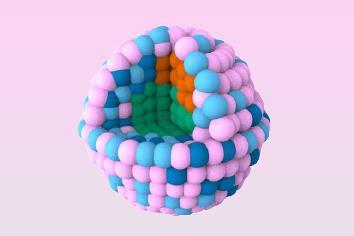
A revolutionary method created by scientists from the United States and South Korea may transform the creation of multimetallic nanoparticles, opening up new possibilities for catalytic applications. In particular, these pentametallic nanoparticles exhibit potential for ammonia decomposition, an essential phase in hydrogen generation. This cutting-edge technique facilitates the spontaneous emergence of nanoparticles from a solution composed of five metals, resulting in a more consistent size and composition compared to traditional methods.
The difficulty in synthesizing multimetallic nanocrystals arises from their ability to exhibit varied catalytic characteristics. However, the variations in the intrinsic crystal structures and reactivities of different metals can result in inconsistent products, making synthesis more complex. Historically, techniques requiring high energy that quickly cool metal mixtures have been used, yet these often lead to phase separation.
In this novel technique, researchers from Stanford University, under the guidance of Matteo Cargnello, and the Korea Advanced Institute of Science and Technology, led by Hee-Tae Jung, implemented a more refined approach. By depositing metals from solutions onto ruthenium nanoparticle seeds and heating them, they investigated various bimetallic configurations. This led to distinct structural outcomes: iron produced separate nanoparticles, copper resulted in core-shell structures, while cobalt and nickel yielded mixtures.
A major advancement was achieved when all five metal precursors were incorporated into the blend. Rather than yielding a variety of products, the distribution unexpectedly became more uniform, forming RuFeCoNiCu particles with reliable composition. Time-lapse observations revealed a sequence of metal deposition commencing with copper, succeeded by other metals, resulting in a structured nanoparticle.
At a temperature of 900°C, this multimetallic catalyst reached a catalytic rate four times greater than that of ruthenium alone for ammonia breakdown. Although the catalyst demonstrated reduced effectiveness under ammonia synthesis conditions, support from BASF’s California Research Alliance Program underscores its potential contribution to the hydrogen economy.
Peidong Yang from the University of California, Berkeley, commends the study’s innovative temperature-regulated methodology, despite the intrinsic compositional challenges stemming from the varying chemistry and crystal lattices of the metals. The broader applicability of the technique remains a pivotal inquiry, as its possible universality could pave the way for substantial progress in nanoparticle synthesis.