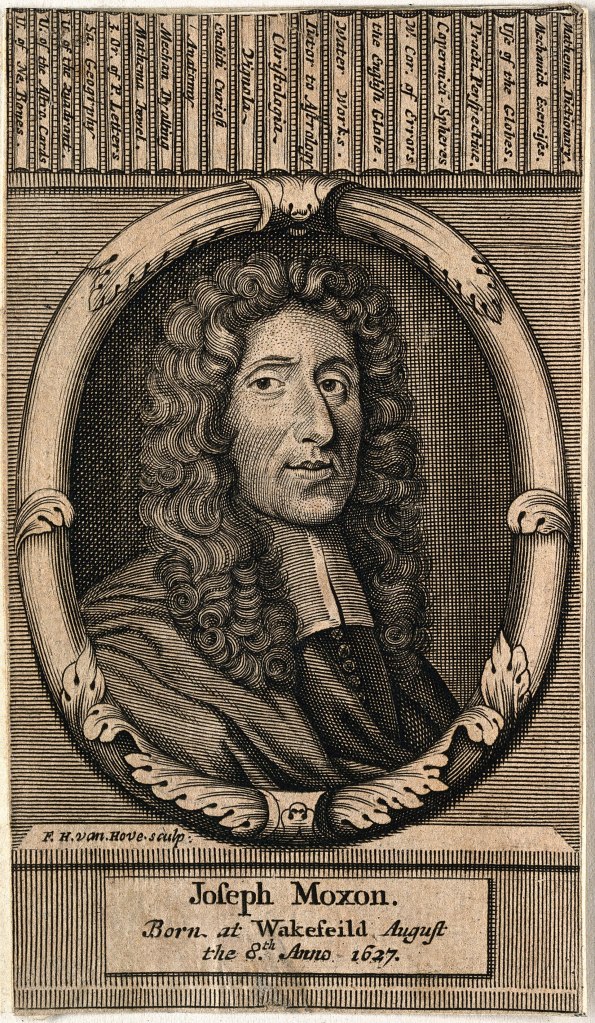
Emery Molyneux, recognized as the inaugural English maker of printed globes, established a benchmark in 1590s England with his esteemed globes. Following his relocation to the Netherlands in 1597, the art of globe-making was resumed after sixty years by Joseph Moxon, who emerged as a significant character in the world of practical mathematics, thereby linking England and the Netherlands during the Early Modern Period. Born in Wakefield in 1627, Moxon hailed from a family with religious ties that prompted their movement across Europe due to the era’s religious unrest. He was raised within the Puritan community in the Netherlands, where his father was involved in printing Puritan literature and English Bibles.
Upon his return to England after 1646, Moxon became a dynamic entrepreneur in the sphere of globe and map making. By the mid-17th century, his activities had broadened to include the production of terrestrial and celestial globes alongside a variety of mathematical instruments, making them more accessible via economical printed paper devices. His varied portfolio also encompassed the publication of well-liked scientific literature and manuals addressing an array of practical topics. Moxon played a crucial role in disseminating knowledge of trades through his prominent works such as “Mechanick Exercises or, The Doctrine of Handy Works,” which reflected the waning secrecy surrounding trade skills.
Joseph Moxon’s influence further reached into the domain of scientific literature, with distinguished contributions in printing and dictionary publications. His endeavors opened avenues for public accessibility to complex scientific practices, advancing education and exploration in mathematical, astronomical, and technical realms. This recognition led to his appointment as Hydrographer to the King and his membership in the Royal Society, highlighting his vital role within the 17th-century scientific community of London.
Although groundbreaking discoveries and celebrated figures frequently dominate historical accounts, Joseph Moxon’s narrative underscores the essential contributions of skilled practitioners whose efforts established critical foundations for wider scientific inquiry and progress. His transformation from a Puritan refugee into a distinguished scientific figure demonstrates the interaction of political, religious, and intellectual forces in shaping the scientific developments of that period.