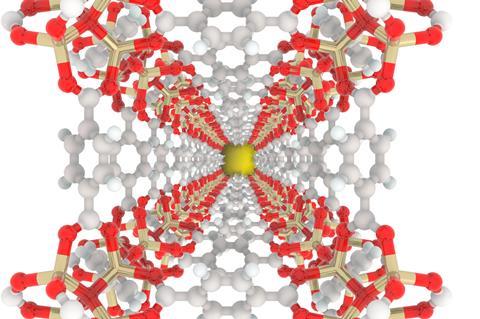
By subjecting the exterior of a reaction vessel to an alternating electric field, chemists have significantly decreased the time required to produce various metal–organic frameworks (MOFs). The scientists responsible for this advancement report that this straightforward technique shortens reaction durations to under an hour, eliminating the necessity for heat or supplementary catalysts.
Traditionally, chemists create MOFs by combining dissolved metal salts and organic linkers within a sealed environment. However, these solvothermal approaches can consume considerable energy, often necessitating overnight reactions and potentially causing dangerous pressure buildup within the reaction vessel.
Researchers in China have now adopted an alternative technique by encasing two ring electrodes around the exterior of a glass test tube and applying a voltage. The resulting electric field hastens the synthesis of several well-known MOFs, such as UiO-66 and MOF-5. Reactions were completed in a timeframe of 15 to 60 minutes, contingent on the metal and organic linker employed, thereby minimizing the energy and duration required to produce these highly porous substances.
By irradiating the reaction mixture of a specific zirconium-based MOF with a laser, the team was able to assess the rate of MOF development and consequently the activation energy barrier. Their analysis indicated that the electric field’s presence diminished the apparent energy barrier by approximately 20% in comparison to conventional synthesis techniques. The researchers propose that this phenomenon results from the electric field enhancing the reactivity of the reactants and decreasing the energy necessary for the two reactants to combine.
Moreover, the team discovered that initially activating the metal salt using the electric field prior to incorporating the organic linker resulted in the immediate formation of the MOF.
Although this technique currently functions only at a gram scale, the researchers believe that utilizing flat-plate electrodes or multiple electrodes could further facilitate the scaling up of this technology.