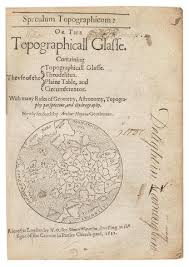
In the middle of the 16th century, England emerged as a center for swift developments in navigation, cartography, surveying, and artillery. This evolution generated a necessity for innovative systems and enhanced skills. As a result, mathematical professionals commenced publishing their works, which were soon followed by a surge of ingenious instrument makers. These artisans conceived and produced new mathematical devices essential for applying the contemporary techniques.
The progression of these fields created a demand for instructors who could educate others on the use of advanced systems and tools. Notable mathematicians John Dee and Thomas Harriot were recruited by budding exploration enterprises to assist sailors in charting and navigating new lands during their exploratory endeavors. Institutional initiatives to formalize this education included the brief appointment of Thomas Hood as the inaugural Mathematical Lecturer to the City of London in 1588. Though his lectures were short-lived, they gained traction. The establishment of Gresham College in 1597 further propelled this educational initiative, though concerns arose regarding its effectiveness in reaching a wider audience. Additionally, Edward Wright, hired by the East India Company for his mathematical knowledge, symbolized the period’s growing dependence on scholarly teaching.
The rising interest generated a demand for independent mathematical educators who provided private tutoring. This trend enabled individuals such as John Speidell and his son Euclid to flourish as private mathematics tutors. These educators made notable yet subtle contributions to London’s educational sphere. For instance, John Speidell published “Speidell’s Geometrical Extraction,” which allegedly motivated young men toward the study of geometry.
John’s educational background was illustrious; his father, Sebastian Speydell, a prominent merchant from Germany, had accrued wealth through mining enterprises under Elizabeth I. Following Sebastian’s death, his financial fortune waned, but his son’s passion for mathematics and music eventually overshadowed business endeavors. After marrying a widow of a fellow mathematics teacher, John began his teaching career, offering classes in English, French, and Dutch starting in 1607, continuously adapting to societal and technological shifts—most notably engaging with John Napier’s newly developed logarithms.
His son Euclid Speidell inherited this heritage of mathematical skill, mirroring his father’s focus on practical, applicable mathematics. This emphasis on utility rather than theory was common in a society that valued practical applications of mathematics such as surveying and astronomy. Euclid’s services reached esteemed circles, reflecting his father’s clientele—often courtiers seeking mathematical guidance.
The interconnectedness of London’s mathematical community supported intellectual development during turbulent civil periods. The efforts of John and Euclid Speidell narrate a tale of education intertwined with innovation and application, evident through collaborations with distinguished instrument makers like Elias Allen, fostering a setting where mathematics flourished beyond formal academia.
This account encapsulates the transition of the 17th century towards specialized education facilitated by mathematical practitioners, crucial in spreading knowledge across different social levels. These narratives were primarily sourced from Boris Jardine’s essay in “Beyond the Learned Academy: The Practice of Mathematics 1600–1850.”