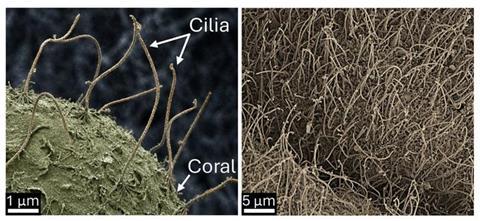
Elevated temperatures have been found to interfere with the functionality of cellular components responsible for oxygen delivery to corals. This discovery uncovers a novel stress mechanism that connects warmer seas to coral mortality. Beyond their significance in the ocean ecosystem, corals are vanishing rapidly as climate change continues to escalate. Researchers aiming to comprehend the biological processes contributing to coral stress have illustrated how increasing temperatures impact minuscule structures known as cilia, which are present on the outer layer of coral tissue.
Cilia are slender formations, approximately 10–15 micrometres in length and 500 times thinner than a human hair. They move in a synchronized wave-like pattern, transporting trapped particles within the coral’s mucus to cleanse the surface and provide nourishment to the mouth opening. Additionally, they generate localized flows of oxygen-rich water surrounding the coral.
A research team spearheaded by University of Copenhagen scientists Cesar Pacherres and Michael Kühl focused on the area of flow identified as the concentration boundary layer. They introduced particles around 500 nanometres in size, coated with an oxygen-sensitive dye, into the water around the coral and illuminated the particles using a laser. The dye utilized shines more brightly based on the level of oxygen present.
Images were captured with a camera linked to a long-distance microscope, and the team analyzed these images to ascertain the movement and concentration of oxygen at the coral surface. By combining this data with high-speed recordings of cilia movement, the researchers examined the correlation between movement and oxygen absorption at different temperatures.
This technique was specifically developed for the research. ‘We needed to innovate and find new methods to visualize the processes because we are dealing with extremely small scales, and existing techniques were inadequate,’ states Pacherres. ‘It required collaborative efforts over a period of several years,’ he adds.
The investigation revealed that with moderate temperature rises, the cilia beat more rapidly, enabling the coral to meet increased metabolic oxygen needs. However, at elevated temperatures, the demand for oxygen outpaced the cilia’s ability to provide adequate oxygen flow, resulting in a progressive depletion of oxygen in the boundary layer.
At 37°C, the rhythm of the cilia deteriorated, leading to a decline in the oxygen supply for the corals. ‘At that moment, the coral is in a precarious state … we observed tissue disintegrating,’ according to Kühl.
Early Alert
Historically, coral bleaching has been regarded as one of the most dependable indicators of coral stress. This phenomenon occurs when corals expel the vibrant algae residing in their tissues, which are essential for their energy needs. Following an extended duration without these algae, corals face starvation. However, bleaching generally manifests during extended stress periods. The new findings indicate that an alternative stress mechanism can arise much earlier and more abruptly than bleaching.
Ilsa Kuffner, a marine biologist at the US Geological Survey, has witnessed the impact of abrupt temperature surges in her research on elkhorn and staghorn corals in the Caribbean. Previously thought to be moderately susceptible to bleaching, she has observed a rapid change in the resilience of these species over the past five to ten years.
‘When temperatures reach these extremes, you arrive at a different level that could initiate a completely distinct process, and this [research] proposes a mechanism that clarifies some of the phenomena we’ve noted,’ she explains.
Furthermore, she has observed this effect occurring at temperatures significantly lower than those cited in the study. ‘They mention temperature thresholds of 37°C, but in reality, that could be even lower, particularly when winds calm and conditions are stagnant … we are witnessing, for several coral species, these acute-stress responses at 32–33°C,’ she remarks.
These discoveries could guide decision-makers on prioritizing conservation initiatives. Lucy Gorman, a coral biologist at the Marine Biological Association in the UK who focuses on coral stress, notes, ‘It prompts considerations about currents and water movements.’ She adds, ‘If the [corals are] situated where water movement is considerably higher … perhaps they become oxygen-saturated, enhancing their survival under elevated temperatures.’
Pacherres and Kühl aspire that their discoveries may serve as early indicators not only for corals but for other marine species as well. ‘Numerous other organisms possess cilia and utilize them to generate feeding currents or to oxygenate themselves,’ Kühl states. ‘[Thus] this type of mechanism could also be pertinent to other species within various ecosystems.’