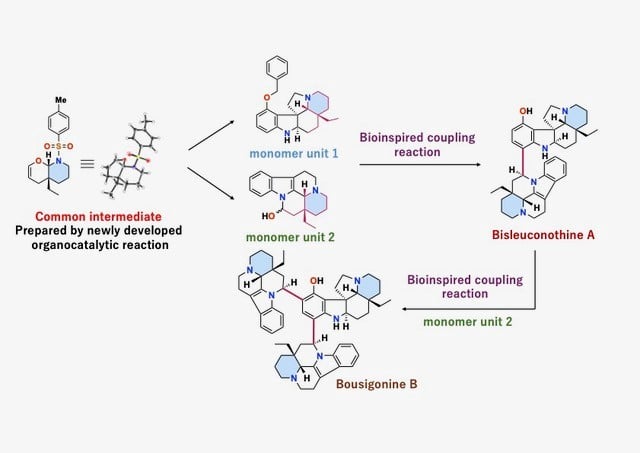
The molecule was initially extracted from a segment of plant bark in 2010, and chemists have been investigating it ever since. Bisleuconothine A. It eliminates breast cancer cells. It eliminates lung cancer cells. And for sixteen years, no one could synthesize the substance in a laboratory, which meant that anyone aspiring to convert it into a drug was, effectively, depending on the patience of a tree.
That wait might be coming to an end. A team at Chiba University in Japan has successfully assembled bisleuconothine A in the lab, atom by atom, marking the first occasion the compound has ever been constructed from the ground up.
To comprehend why this took such a long time, one must examine what the molecule actually is. Bisleuconothine A is part of a vast family known as monoterpenoid indole alkaloids, or MIAs, and it is categorized as an awkward oligomeric molecule, meaning it is pieced together from multiple alkaloid units into a large, irregular three-dimensional configuration. This size is precisely what makes it appealing to drug developers. Traditional small-molecule drugs are typically flat and orderly, making them inadequate at inserting themselves into the interfaces where two proteins come together, but a sizable, twisted molecule like this one might just manage to fit in there and disrupt the contact.
Disrupting those protein-protein interactions has long been a goal in oncology. The challenge, however, has always been acquiring enough of the molecules that can achieve it.
Plants create these compounds effortlessly, of course, utilizing enzymes honed over millions of years. Chemists, without that machinery, encounter a structure filled with interlocking rings and multiple stereocenters, the points where the molecule’s atoms must be ordered in a specific handedness and no other. Misarranging even one can result in a total loss of biological activity. Therefore, drug research on oligomeric MIAs has struggled, lacking adequate material.
One Building Block to Rule Them All
The Chiba group, led by Hayato Ishikawa, approached the problem from a different angle. Instead of painstakingly crafting a custom route for each molecule, they first constructed a single versatile fragment and then expanded from there.
This particular fragment is a chiral 3-ethylpiperidine scaffold, a small ring system that frequently appears throughout the MIA family, and the team facilitated its creation through a process known as organocatalysis: a form of chemistry propelled by small organic molecules rather than the metal catalysts that predominantly dominate much of synthesis. The reaction takes place as a cascade, with several transformations occurring sequentially in one container. A chiral amine catalyst propels a Michael addition forward, ensuring the correct handedness from the beginning, and a couple of additional steps (a cyclization followed by an acetalization) refine the piece into a pure, reusable intermediate. Importantly, they only required a small amount of catalyst to accomplish it. From that singular common building block, they then crafted two distinct alkaloid fragments and connected them using a coupling reaction intentionally designed to emulate how a plant might naturally join the units.
This biomimetic step is the refined element. It produced bisleuconothine A in 20 steps.
And then the process continued. With one more step, the same strategy yielded a second, even more intricate molecule called bousigonine B, a trimeric MIA constructed from three alkaloid units instead of two, marking the first instance anyone has completed the total synthesis of a trimeric MIA. The research, published in Angewandte Chemie International Edition on 23 May, also subtly rectified the record: the team discovered that the established absolute stereochemistry of bousigonine B was incorrect, and their synthesis amends it.
From Bench to Bedside, Eventually
None of this results in a cancer drug immediately. A total synthesis serves as evidence that the molecule can be made and produced cleanly, not a finalized therapy, and there is an extensive journey of biological testing between a flask of pure compound and anything a patient might receive. Nevertheless, having a trustworthy supply alters what is feasible to even consider.
“The current method for total chemical synthesis is anticipated to enhance the development of new pharmaceutical agents. In particular, bisleuconothine A has demonstrated strong anticancer activity, underscoring its potential as a lead compound for anticancer drug development,” remarks Ishikawa.
The greater reward, arguably, is not either molecule individually but the strategy that led to both. Because numerous alkaloids share that 3-ethylpiperidine core, a