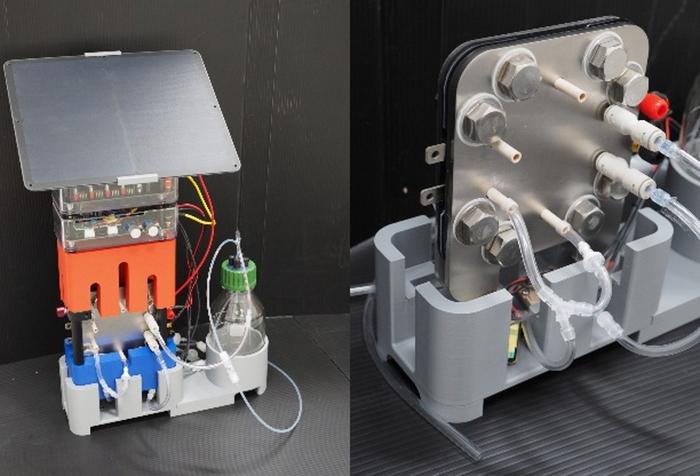
On a somewhat overcast morning in Osaka, atop a university structure, a compact cube made of titanium and plastic membranes commenced the subtle process of converting carbon dioxide into liquid fuel. It went unnoticed. No supervision was required. With the sunrise, it activated; with sunset, it ceased. During the day, as clouds drifted through the sky and the illumination fluctuated, the device simply adapted, drawing energy from the solar panels above and transforming water and CO2 into purified formic acid.
What was missing is the intriguing detail. There was no battery. There wasn’t a bank of control electronics determining how to extract the maximum energy from the solar cells at any given moment. That apparatus, typically the expensive core of any solar-fuel system, was completely omitted.
Artificial photosynthesis aims to mimic the function of a leaf, but on our own terms: harness sunlight, water, and carbon dioxide, storing the energy in a chemical that can be retained. In most configurations, an electrolyzer stands at the forefront, converting electricity from solar panels into a storable chemical energy, specifically formic acid in this case. The challenge arises from the inconsistency of sunlight. Its intensity varies with weather conditions and time of day, and a solar cell has a specific voltage at which it operates at peak performance, that sweet spot, which fluctuates as conditions change.
To optimize that sweet spot, engineers typically implement a system called maximum power point tracking, or MPPT. While effective, it often relies on a battery and additional electronics to ensure a smooth flow of energy.
This created a paradox that troubled the team behind this recent innovation. The primary goal of solar fuel is to produce energy affordably, yet the standard solution for achieving stability involves an expensive battery. This results in two entities that store solar energy, the battery and the fuel, essentially performing the same task. This redundancy also drives up costs.
Thus, the researchers, led by Yasuo Matsubara and Yutaka Amao at the Research Center for Artificial Photosynthesis at Osaka Metropolitan University, in collaboration with Iida Group Holdings, posed a challenging question. What if the electrolyzer could independently track the sun’s sweet spot?
Utilizing Heat Instead of Hardware
Their solution leverages a unique aspect of physics. Inside the electrolyzer is a solid-state electrolyte, a material whose electrical resistance behaves counterintuitively: as it heats up, it conducts electricity more efficiently instead of less. An electrolyzer operating under bright sunlight naturally warms up.
“With increased sunlight, the electrolyzer naturally heats up. The system is engineered such that this warming reduces electrical resistance, facilitating a freer flow of electricity,” Amao explains. “This allows the system to autonomously adjust its electrical characteristics.”
As such, the device identifies the panel’s maximum power point not through a microchip measuring voltages against currents but through straightforward thermodynamics. More sunlight leads to more heat, lower resistance, and higher current. Conversely, dimmer light results in a cooler cell, increased resistance, and reduced current. The interplay between chemistry and heat transfer regulates this process, with low-power pumps fine-tuning the water flow to adjust how much heat the system releases. The researchers refer to it as a chemical MPPT, and it appears to be the first of its type for this category of electrolyzer. “This self-regulating mechanism ensures more stable fuel production throughout the day and automates the system, while minimizing reliance on batteries and costly external components,” adds Amao.
Their optimism was justified. The technology had previously demonstrated its capabilities at the Osaka Kansai Expo 2025, where a version powered a small exhibit. “We were confident in its success, as we had showcased this research at the ‘Joint Pavilion Iida Group × Osaka Metropolitan University’ exhibition during the Osaka Kansai Expo 2025,” states Matsubara. “It effectively generated enough formic acid to power a miniature diorama in the pavilion, highlighting its potential as an efficient artificial photosynthesis system that could be utilized for energy applications in our homes.”
From Diorama to Rooftop
The pivotal test occurred atop a rooftop in Sugimoto, Osaka, in May 2024, on an intermittently clouded day. A standalone apparatus, comprising four electrolyzers connected in series behind a commercial monocrystalline-silicon panel, operated autonomously from dawn until dusk. Throughout that sole day, it produced approximately 3.3 kilograms of formic acid solution, around 3 percent by weight, with a purity exceeding 98 percent, derived solely from CO2 and pure water. Importantly, the concentration remained relatively stable despite the fluctuations in light, which is the very stability a battery would typically provide.
The key figures that matter most, at least for the specialists in this domain, are two. The system utilized about 85