**The Surprising Counterclockwise Preference in Human Movement**
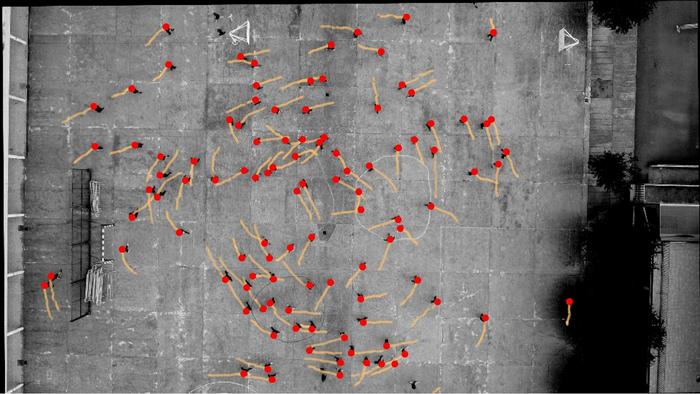
Out of thirty-three instances, the group consistently turned in one direction. Left. Always left, circling counterclockwise around the space like water draining, and the researchers reviewing the aerial footage hadn’t anticipated discovering this. Their focus was on figuring out how to maintain a two-meter distance among pedestrians during the pandemic. What they uncovered instead was a subtle, persistent asymmetry hidden in human motion.
The research team, collaborating across Spain and Japan, established a typical type of experiment: volunteers wandering within a circular space, cameras positioned above, software monitoring every step taken. The intent was to enforce social distancing. The spiral occurred by chance.
“While evaluating the experiments, my colleagues discovered unexpectedly that in 32 out of 33 experimental sessions, as individuals moved and turned, they clearly favored turning counterclockwise,” explains Claudio Feliciani, a project associate professor at the University of Tokyo who was drawn into the investigation from afar. The figures were compelling. Yet, statistics seldom clarify themselves, and this is where the narrative takes a peculiar turn.
For the straightforward explanations kept unraveling. One might logically assume that people turn whichever way they feel is right at that moment, with no universal pattern. “This was entirely unforeseen as, at least instinctively, when individuals walk randomly, you picture them turning to suit their needs, showing little indication of a general preference,” remarks Feliciani. And yet. “There was a distinct, quantifiable inclination for individuals to turn counterclockwise rather than clockwise, all factors considered.”
**Eliminating the Common Explanations**
When encountering something unusual, conventional wisdom suggests investigating from every possible angle until the mystery is unraveled. So that’s precisely what they did across five distinct experimental efforts. Culture was the initial culprit, which is why the Japanese team was engaged in the first place. In Spain, pedestrians tend to sidestep to the right; in Japan, they veer left. Different nations, different ingrained customs. If evasion tactics were causing the spiral, the two countries should have revolved in contrary directions.
They did not. Both turned counterclockwise.
Next came the walls. Perhaps the arena’s border was guiding people, similar to a marble in a bowl. Thus, the researchers took over a hundred and seven teenagers to a 50 by 60-meter schoolyard in Pamplona, an open area without constraints to push against, and observed them move. The counterclockwise tendency persisted. If anything, it was clearer. They dismissed handedness, footedness, eye dominance, sex, and even group size: none had a significant impact. “It likely doesn’t originate from the eyes, as we tried patching people’s left or right eyes and the bias remained,” says Feliciani. They also carefully rejected more outlandish theories that surfaced. “Some suggested it might be large-scale phenomena like the Coriolis effect or the Earth’s magnetic field, but this seems improbable based on what we’ve identified so far.”
**It Wasn’t Just a Crowd Phenomenon**
Here comes the twist that changes everything. For years, the prevailing belief in crowd science has been that collective behaviors, the lanes and currents visible in bustling streets, arise from individuals responding to one another. The group is assumed to be greater than the sum of its parts. Yet, when the team finally placed over two hundred volunteers in an enclosure and had them walk entirely alone, one at a time, the spiral remained. The bias was present in the individual walker, statistically undeniable (a Wilcoxon test suggested the likelihood of coincidence was less than one in a thousand). This indicates that the counterclockwise tendency isn’t something a crowd creates together. Each person, it seems, inherently possesses a slight leftward inclination, and a group merely makes it apparent.
The team even investigated whether some silent social convention might be influencing behavior, polling 168 individuals about which way they might expect to walk. If anything, the replies leaned in the opposite direction, towards clockwise, which is exactly the contrary to what people actually do. So much for etiquette as an explanation.
The children represent the intriguing thread worth exploring. In a Japanese preschool, five-year-olds allowed to run freely during a music activity didn’t merely drift counterclockwise; they embraced it, nearly the entire group moving in synchrony. “Among all these observations, the only notable finding was that children tend to exhibit a more pronounced inclination for the counterclockwise direction, suggesting that age may play a role in amplifying or diminishing the effect,” states Feliciani. This implies the propensity is an innate trait that we gradually learn to suppress rather than something we acquire.
So, what is the reason?