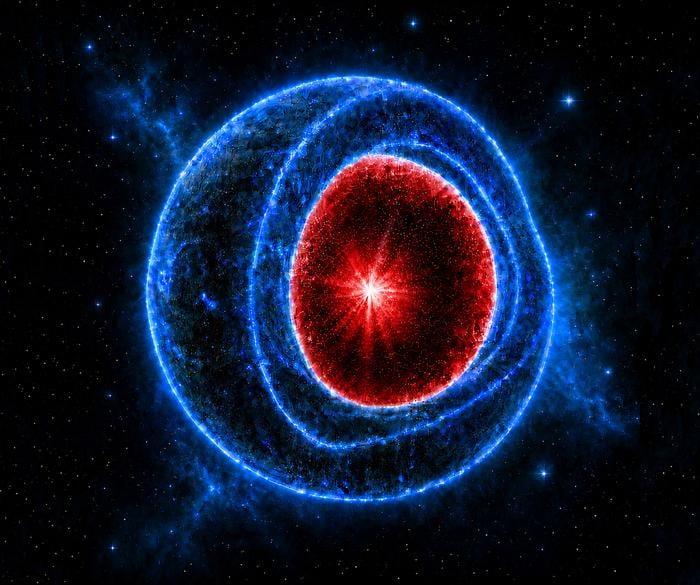
The most extreme entities in the cosmos might be non-existent. Black holes, the colossal remnants of imploded matter that serve as anchors for entire galaxies and distort light around them, present a predicament at their core, quite literally: a point of infinite density where the principles of physics simply fail. Recently, two theoretical physicists in Frankfurt have devised a method for nature to completely circumvent that dilemma. Their solution involves something rather astonishing, a second Big Bang igniting within a dying star.
The concept seems like a plot from science fiction. However, the mathematics, released this week in Physical Review D, tells a different story.
Begin with the fate of a particularly massive star that has depleted its fuel. For billions of years, the energy produced by nuclear fusion exerts an outward force, counterbalancing the star’s own crushing gravity. Once the fuel is exhausted, that support disappears, and the star implodes. According to the conventional understanding, nothing can halt this descent. The matter compresses past a point of no return, an event horizon seals off around it, and everything funnels into a singularity, a point where spacetime is curved infinitely, where as much as ten billion solar masses (in the most extreme instances) can occupy a volume smaller than an atom.
Physicists have always harbored some discomfort with this scenario. Infinities within equations typically indicate that a theory has been stretched beyond its limits, not that nature behaves in such a manner.
The Star That Hides in Plain Sight
Introducing the gravastar, a theoretical alternative first suggested approximately 25 years ago. Externally, a gravastar would appear almost identical to a black hole: nearly as compact, nearly as massive, and dark due to light struggling to escape its intense gravity. Internally, however, the situation is dramatically different. There is no singularity and no event horizon. Instead, the object is filled with dark energy, the same enigmatic substance believed to be accelerating the expansion of our universe, which exerts an outward push that counteracts collapse. An outer shell of ordinary matter envelops it. Neat, in a sense. No infinities necessary.
The hitch, and it has been a significant one, is that no one could elucidate how such an entity would actually form. A quarter-century of discussions yielded no persuasive mechanism.
Daniel Jampolski and Luciano Rezzolla at Goethe University Frankfurt have now discovered one, emerging not from some unusual alteration of gravity but from Einstein’s general relativity, the same 110-year-old theory that initially predicts black holes. Jampolski found the solution while working on his master’s thesis under Rezzolla’s guidance. The pair simulated the collapse of a sphere of matter, the classic scenario that physicists have studied since 1939, and found that under precisely tuned conditions, something extraordinary occurs at the core. A minuscule bubble of expanding spacetime, referred to by cosmologists as a de Sitter region, emerges from a state of zero size in the midst of the infalling matter. It then expands, driven by dark energy, in a fashion reminiscent of the Big Bang that created our own universe approximately 13.8 billion years ago.
An Expansion That Knows When to Quit
Here lies the genuinely elegant aspect. The expansion of this mini-universe does not spiral out of control. It decelerates naturally as it nears the Schwarzschild radius, the threshold at which an event horizon would typically form, where it encounters the collapsing surface of the star converging the other way. The two forces establish a balance. Expansion pushing outward, gravity pulling inward, resulting in a static equilibrium: a stable gravastar, poised at the edge of becoming a black hole but never tipping over.
“The Big Bang of the emerging universe can manifest once the star has almost completely collapsed to the verge of transforming into a black hole,” Jampolski clarifies. The intense compression is critical, he posits, because it is precisely at this juncture that established physics becomes unstable. “It is simpler to envision that the Big Bang transpires only at a very late stage when matter has already been subjected to extreme compression, thus giving rise to new phenomena.”
However, there are limitations. The team discovered that a collapsing star can only follow this exit route if its initial compactness remains below a specific mathematical threshold, a value of exactly 3/8. Compress the initial setup any more tightly, and the transition to a black hole becomes inevitable, mini Big Bang or otherwise. Additionally, the conditions must be finely calibrated, which may