**Exploring Reaction Times in Cognitive Psychology: An Historical and Contemporary Overview**
Psychologists have been assessing reaction times since before psychology was officially recognized as a field. Reaction times, defined as the time required to react to a stimulus, have consistently been a key element in cognitive psychology investigations, enabling researchers to deduce variations in cognitive processing across different settings.
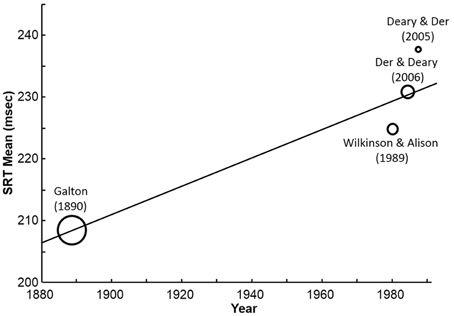
In the latter part of the 19th century, Francis Galton, a notable personality in statistics and eugenics, amassed a vast collection of reaction time data from 3,410 subjects. Galton’s focus diverged from that of modern psychologists as he regarded reaction times as a possible indicator of personal differences, especially regarding intelligence. He proposed that quicker reaction times reflected faster cognitive processing and, by extension, superior intelligence.
This historical dataset presents a fascinating chance: contrasting contemporary reaction times with those of Galton may highlight not only disparities in immediacy of responses but also more extensive alterations in cognitive abilities through generations. This examination offers a counterbalance to the Flynn Effect — the marked increase in IQ scores over time, which seems to challenge the belief that humanity is becoming less intelligent.
Unexpectedly, new evaluations of reaction time data could imply the reverse trend: a deceleration in present times. Investigations juxtaposing Galton’s findings with more recent research suggest that today’s participants frequently display slower reaction times. One investigation by Silverman (2010) noted that reaction times in the 20th century were generally slower than those documented by Galton. Such results have been supported by Woodley et al. (2013, 2015), indicating a secular decline in simple reaction times over the span of a century — approximately a 20-millisecond increase, which is considerable in terms of reaction time.
These findings evoke several inquiries regarding potential factors: Is there a true decline in cognitive ability? Does modern existence impose heavier cognitive demands, thus affecting simple reactions? Are there shifts in motivation, or perhaps differences in how experiments are conducted and interpreted today? While the exact explanations are still unclear, these results question our comprehension of cognitive development and highlight the intricacies of aligning historical data with contemporary frameworks. The discussion continues, but one fact remains evident: the study of reaction times is as significant now as it was more than a hundred years ago.
**References:**
– Irwin, W. S. (2010). Simple reaction time: it is not what it used to be. *American Journal of Psychology*, *123*(1), 39-50.
– Woodley, M. A., Te Nijenhuis, J., & Murphy, R. (2013). Were the Victorians cleverer than us? The decline in general intelligence estimated from a meta-analysis of the slowing of simple reaction time. *Intelligence*, *41*(6), 843-850.
– Woodley, M. A, te Nijenhuis, J., & Murphy, R. (2015). The Victorians were still faster than us. Commentary: Factors influencing the latency of simple reaction time. *Frontiers in Human Neuroscience*, *9*, 452.