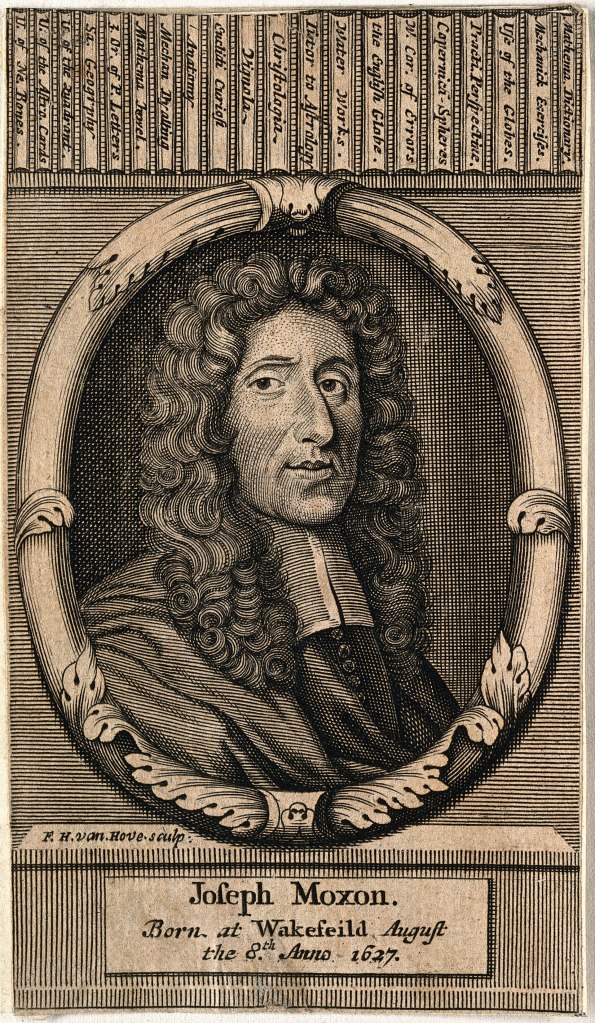
**Joseph Moxon: England’s Globe Creator and Mathematical Pioneer**
Joseph Moxon, an important yet frequently unrecognized individual in England’s Early Modern Period, connected practical mathematics with the spread of scientific knowledge through his remarkable achievements in globe creation, publishing, and mathematical instruction. Born in 1627 in Wakefield, England, Moxon’s life was closely linked with key historical developments and influential personalities of his era.
**Early Years and Heritage**
Moxon was raised in a Puritan environment; his father’s dissent against Archbishop William Laud’s policies compelled the family to move to the Netherlands in 1636. There, James Moxon printed Puritan tracts and English Bibles, laying the groundwork for Joseph’s future pursuits in printing and publishing.
**Return to England and Professional Growth**
After returning to London in 1646, the Moxon siblings continued their printing activities. Joseph, however, sought to expand beyond his family’s enterprise. His fascination with globe and map crafting took him to Amsterdam in 1652, where he acquired copper globe-printing plates. By the end of that year, he was manufacturing and marketing terrestrial and celestial globes, establishing his presence at the sign of the Atlas in London. Moxon embraced applied mathematics, offering affordable printed paper instruments alongside his globes and maps.
**Contributions to Mathematics and Science**
Moxon launched his publishing career with “A Tutor to Astronomy and Geography” in 1654, revealing the secrets of the celestial and terrestrial realms to the English populace through Willem Janzoon Blaeu’s knowledge. Over the next thirty years, he published numerous scientific texts and manuals, broadening the scope of practical mathematics.
His acclaim as a printer of mathematical literature was confirmed with publications such as John Dansie’s “Mathematical Manual” and the tables found in William Oughtred’s “Trigonometria.” These initiatives highlighted his commitment to making mathematical understanding accessible and applicable.
**Acknowledgment and Impact**
Moxon’s aspirations and networking abilities resulted in his designation as Hydrographer to King Charles II in 1661, marking his rise from the son of a religious exile to a prominent figure in the royal court. His involvement with the Royal Society and election as its first tradesman fellow in 1678 further solidified his position within England’s scientific community, establishing relationships with distinguished scholars like Robert Hooke and Edmond Halley.
**Trailblazing Publications and Heritage**
Moxon’s groundbreaking publications, particularly the “Mechanick Exercises,” offered comprehensive guidance on trades and sciences, making knowledge that was typically reserved for guilds more accessible. His later work, “Mechanick Exercises: Or the doctrine of handy-works applied to the art of printing,” was a pioneering exploration of the printing process.
Moreover, Moxon’s “Mathematicks made Easie,” the first mathematical dictionary, acted as a guide for those wishing to grasp the terminology of mathematics, showcasing his dedication to education and accessibility.
**Final Thoughts**
Joseph Moxon’s role as a globe creator, publisher, and educator was vital in molding the scientific dialogue of his era. His contributions, though often eclipsed by more celebrated figures, played a key role in transforming isolated scientific inquiry into a vibrant community in 17th-century England. Through his innovations and writings, Moxon made certain that practical mathematics became a fundamental element of society’s educational framework, securing his place in the chronicles of scientific history.