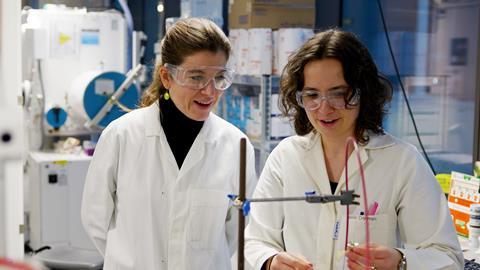
Electron paramagnetic resonance (EPR) spectroscopy may not be as widely recognized among chemists as nuclear magnetic resonance (NMR) spectroscopy, but Maxie Rößler is committed to demonstrating its importance.
‘You can consider EPR somewhat similar to NMR, but pertaining to unpaired electrons rather than nuclei,’ Rößler clarifies. The technique operates by positioning a sample within a magnetic field and observing how its unpaired electrons interact with microwave radiation, thus providing insights into its local chemical surroundings and structure. ‘Many scientists might view it as a specialized technique, though it’s certainly underutilized.’
Since EPR spectroscopy relies on unpaired electrons while most molecules are diamagnetic, the variety of systems suitable for EPR examination is limited. Despite this, numerous reactions pass through crucial paramagnetic states, and increasingly advanced tools are available to capture and analyze these states. Particularly for biomolecules, the use of spin labels like nitroxides has broadened EPR’s applicability, revealing ‘new pathways and areas that people hadn’t thought about,’ Rößler explains. Nonetheless, her focus has been primarily on unpaired electrons that occur naturally in biological and chemical reactions as well as on inventing techniques to capture them.
Another obstacle to the broader acceptance of EPR spectroscopy, according to Rößler, is its limited teaching exposure at the undergraduate level. At Imperial College London, UK, Rößler conducts three EPR spectroscopy lectures within the second-year chemistry curriculum, and each year, student feedback consistently indicates a desire for more. EPR spectroscopy is also included in the third-year bioinorganic module she teaches, and Rößler has endeavored to integrate the technique into teaching labs as well. Students are now introduced to EPR spectroscopy through a synthetic practical involving copper complexes: ‘Copper in the +2 oxidation state serves as an excellent example for EPR spectroscopy. Its spectrum varies based on the ligand field environment, and this can be effectively related back to group theory.’
When Rößler joined Imperial in 2019, it lacked pulse EPR spectroscopy capabilities. With a £2.3 million equipment grant from the UK’s Engineering and Physical Sciences Research Council, along with support from her department, the broader university, and a network of national and international collaborators, Rößler began establishing the Centre for Pulse EPR (PEPR). ‘I completely underestimated the efforts required for this; there was zero infrastructure in place for our needs,’ she shares, noting that she now possesses more knowledge than she anticipated about electrical power supplies and chillers.
More than a service facility
Located in Imperial’s Molecular Sciences Research Hub in a space originally designated for glass blowing, PEPR now features cutting-edge continuous wave and pulse EPR spectroscopy technology. It serves not merely as a service facility but also as a venue for advancing novel instrumentation and methodologies. ‘We collaborate with UCL [University College London] to enhance the sensitivity limits of EPR.’
‘From the beginning, the goal was to establish a fully open access facility, allowing anyone to apply for time at PEPR,’ she states. Rößler is actively involved in numerous projects conducted at PEPR, many of which lead to new research avenues for her own work.
The fusion of state-of-the-art instrument development, extensive open access, and unique capabilities—including film-electrochemical EPR spectroscopy, a technique originated by Rößler—distinguishes PEPR from other EPR facilities in the UK.
Film-electrochemical EPR spectroscopy enables the simultaneous investigation of electrochemical reactivity and spectroscopic structure. It fixes redox-active molecules as a thin film on an electrode within the EPR resonator, allowing control of its redox state via an applied potential. In situ electrochemistry is performed, capturing intermediates with unpaired electrons concurrently using EPR. However, paramagnetic species like metal centers in biomolecules are often too fleeting to be detected at room temperature. In such instances, the sample is flash-frozen, enabling the analysis of short-lived paramagnetic intermediates through EPR.
Rößler initially contemplated this approach during her PhD at <a title="Fraser Armstrong | Oxford