**Two Cups of Warm Water: Altering Light with Photon Upconversion**
Two cups of warm water will never yield one cup of boiling water. Combine them, and you simply increase the total volume of lukewarm water, nothing beyond that. The energy does not accumulate in that manner. Nevertheless, at the level of individual light particles, that is essentially what a team in Japan has recently achieved in a solid material, using nothing more elaborate than sunlight.
The process is known as photon upconversion, which involves merging two low-energy photons of visible light to create one photon of ultraviolet light. Researchers at Kyushu University in Fukuoka have accomplished this in a stable solid, utilizing light no more intense than typical daylight, and have documented their findings in *Nature Communications*.
Why pursue UV in the first place? Because it has numerous applications. UV light is crucial in curing resins in 3D printing, solidifying gel in dental fillings and nail treatment, and disinfecting air and water. The catch is that ultraviolet light constitutes only a tiny fraction of the sunlight that hits the earth, between 3 to 6 percent depending on measurement criteria, with only a small portion being usable. Thus, while an abundance of visible light is available, it is primarily not beneficial for these applications.
“What we do here is ‘combine’ the energy from two visible light photons to create one ultraviolet photon. It’s a captivating procedure referred to as photo upconversion,” states Yoichi Sasaki, an associate professor at Kyushu’s Faculty of Engineering and the lead author of the study.
**The Crowding Challenge**
The underlying mechanism possesses a suitably dramatic title: triplet-triplet annihilation. A “donor” molecule absorbs a visible photon and elevates its electrons into a high-energy, long-lasting state known as a triplet. It transfers that energy to an adjacent “acceptor” molecule, and when two excited acceptors collide, they annihilate each other, releasing their combined energy as a single UV photon. This works exceptionally well in liquids, where molecules move freely and collide with one another. However, liquids can evaporate, leak, and often rely on toxic solvents, which is not ideal for applications such as a window coating or printer.
Solids should eliminate these issues. The challenge lies in what occurs when the molecules are tightly packed. In solids, Sasaki points out, the molecules are in close proximity and their π electron clouds, which are regions of concentrated electron charge above and below each flat molecule, begin to overlap. If they overlap excessively, the valuable triplet energy dissipates as heat before two triplets can meet. “When that occurs, triplets can easily fade before they can interact. Molecules need to be close enough for energy transfer, yet far enough apart to avoid quenching excitons.”
This was the fine line the team had to walk: Closely packed, but not overly so.
**Creating Space Between Molecules**
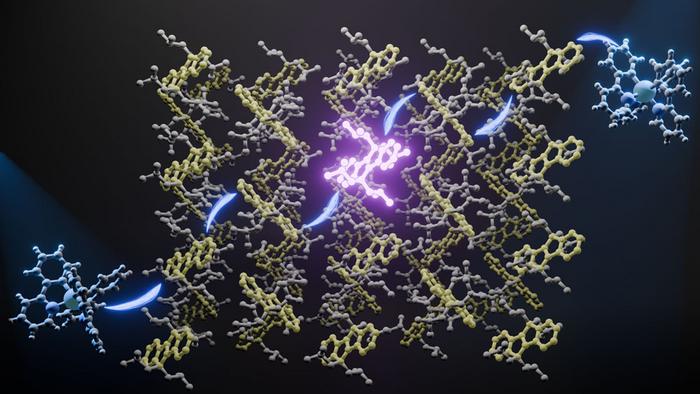
Their solution was a complex organic semiconductor, dihydroindenoindene, or DHI for short. The ingenuity lies in the positioning of the additional chemistry. DHI comprises sp³ carbon atoms, which have four bonds extending in fixed three-dimensional orientations rather than being flat. By attaching short alkyl chains to those carbons, protruding above and below the molecule’s flat π-surface, the researchers incorporated tiny separators within the crystal structure. These chains maintain neighboring molecules at a distance, preventing their electron clouds from interfering with each other while still allowing for effective energy transfer. Among the variations they tested, an isobutyl-tipped version performed best, achieving a solid-state fluorescence yield exceeding 60 percent (with some measurements reaching as high as 83) compared to a mere 10 for the unprotected molecule. Triplet states that would typically dissipate within milliseconds instead lasted for several.
The result is a film that achieves an upconversion efficiency of 1.9 percent. “This signifies that approximately two UV photons are generated for every hundred visible-light photons absorbed,” Sasaki notes. This may not seem significant. The team openly acknowledges this. “While this may sound low, it operates solely on natural sunlight. Most solid-state materials fail to achieve this even under much higher light intensity.”
And that is the essential point worth emphasizing. The intensity threshold required to activate the process is around 1.2 milliwatts per square centimeter, just below the intensity of natural sunlight at the relevant wavelength. There is no laser involved, no concentrating mirror, nor any special equipment. Just daylight streaming through a window. The dense arrangement also offers an advantage: the material remains unaffected by oxygen, the typical destroyer of these excited states, and continues functioning effectively in the open air.