The Notion of Infinity in Calculus and Its Historical Roots
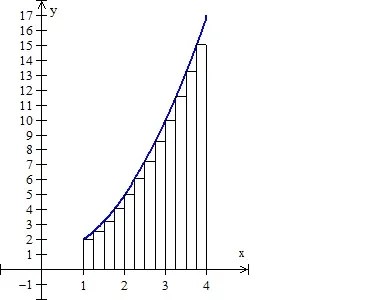
Infinity is essential in calculus, incorporating both the infinitely large and the infinitesimal, which together underpin what was historically referred to as infinitesimal calculus. In the early 18th century, the calculus approach focused on comprehending these ideas through integral calculus, especially when calculating the area beneath a curve represented on a Cartesian coordinate grid.
This technique involved partitioning the area under the curve between two x-coordinate values into uniform rectangles. To compute the area under the curve, one had to sum the areas of these rectangles together with the minuscule triangles formed between the top of the rectangles and the curve. As the rectangles narrowed, these triangles diminished until they effectively vanished, permitting the area under the curve to be determined solely by the aggregate of the rectangles’ areas. The action of taking the sum to its limit presents the philosophical dilemma of adding areas that theoretically no longer exist.
With derivatives, this concept of infinity resurfaces. Derivatives signify the instantaneous rate of change, represented by the slope of the tangent line to the curve at a given point. To find this slope, a secant line is drawn from a point on the curve, and as this line shortens its length approaching zero, the required slope is acquired. This also can be interpreted as the ratio of an infinitesimal alteration in the function’s output to an infinitesimal variation in its input.
The history of infinity traces back to early mathematical societies, which confronted infinite concepts while evolving arithmetic systems. Infinite series and magnitudes were interpreted differently among cultures. The Babylonians leave us ambiguous insights due to the limited translation of clay tablets, while ancient Chinese philosophy presented limitless concepts through ‘wuji.’ The Egyptians embodied infinity with Heh, and the Rhind Papyrus posed an infinite series problem without concentrating on the concept of infinity itself.
Conversely, ancient Indian philosophy and Jain mathematics delved deeply into infinity. The Vedic texts recognized ‘Ananta’ symbolizing the boundless, with various categories differentiating finite from infinite realms. Jain mathematics distinguished between numerable, innumerable, and infinite figures, illustrating various infinite interpretations through specialized techniques for managing them.
The ancient Greeks contended with infinity both philosophically and mathematically. Pre-Socratic thinkers like Anaximander and Anaxagoras introduced notions of boundlessness and infinite division. The Atomists suggested an infinite void filled with atoms. Aristotle, however, conceded only to potential infinity, cautioning against the paradoxes inherent in real infinity. He recounted Zeno’s Paradoxes, such as ‘Achilles and the Tortoise,’ illustrating the intricacies of addressing infinite processes within finite limits.
Euclid’s Elements circumvented real infinity, focusing instead on potential through a proof that contests the existence of a largest prime number. Greek mathematicians also confronted irrational numbers, especially through the Pythagoreans and their struggles with the square root of 2 and Pi. Both were considered incommensurable, unsettling the Greek perspective of the universe as composed of rational numbers.
Infinity’s heritage within mathematics flourished through the approximations of complex numbers like Pi and the square root of two. While the ancient Babylonians and Indians devised early approximations, the Greeks further developed these concepts. The ongoing investigation of incommensurable numbers and their cultural and mathematical repercussions constitutes a significant chapter in the history of mathematics.
The advancement of infinity as a notion remains a vibrant field of inquiry, intertwining philosophical, mathematical, and cultural narratives throughout history.