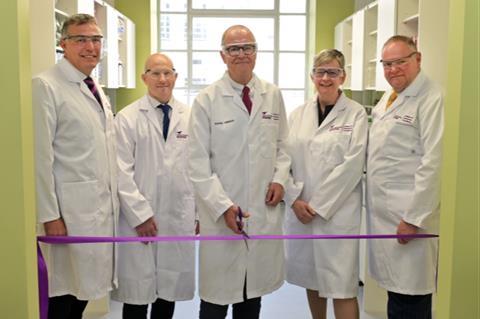
Aston University has recently launched a state-of-the-art research center focused on the development and investigation of membrane technologies. This newly established facility, named the Aston Institute for Membrane Excellence (Aime), aims to expand horizons in areas such as water purification and drug discovery, utilizing both biological and synthetic membrane research.
The establishment of this one-of-a-kind laboratory was facilitated by a considerable £10 million funding from Research England, with £6.1 million earmarked for its construction. The center is strategically placed to promote interdisciplinary teamwork, featuring an open-plan design meant to improve interactions among PhD candidates, postdoctoral researchers, and technicians. Aime hosts a varied team of approximately 60 scientists, leading innovations that concentrate on membrane characteristics crucial to health and environmental issues.
UK science minister Lord Patrick Vallance, who officially inaugurated the laboratory, highlighted the importance of the Aime Laboratory in enhancing research capabilities both in Birmingham and throughout the UK. He stressed its potential to propel scientific advancement and produce life-improving breakthroughs.
Noteworthy projects at Aime include the initiatives led by biochemist Alice Rothnie, who is developing techniques to extract membrane proteins without compromising their structure. This research seeks to broaden the understanding of drug interactions at the cellular level and has the potential to transform drug discovery methodologies. Directors Roslyn Bill and Paul Topham envision Aime as a game-changer, bringing together various scientific fields under one roof to promote seamless exchange of ideas and speed up meaningful discoveries. With the likelihood of overhauling scientific practices, the laboratory plays a crucial role in stimulating research and innovation.
The timing of Aime’s inauguration is significant, as it coincides with Aston University’s strategic transition away from undergraduate chemistry programs due to financial changes and evolving academic focuses. Directors Bill and Topham are hopeful about the lab’s ability to redefine scientific research frameworks through its collaborative environment.