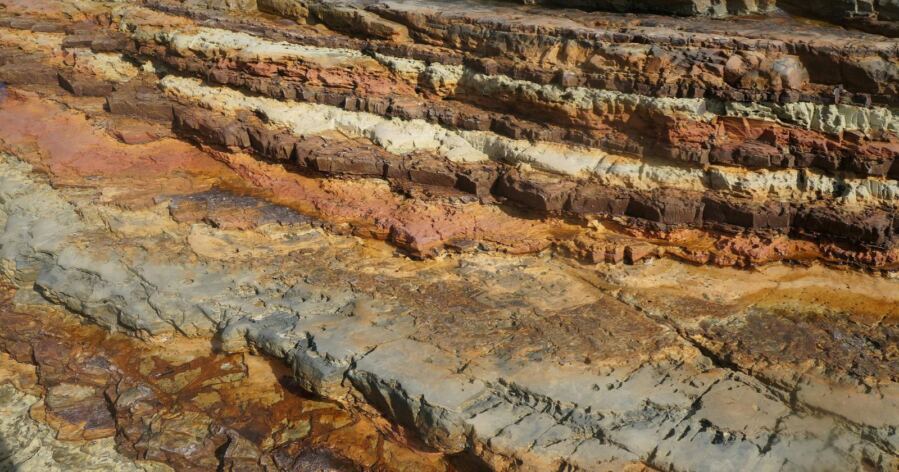
Somewhere in the low, reddish-brown hills situated north of Perth, in a secluded region of Western Australia known as Jack Hills, a geologist crouched down in 2001 and retrieved a rock fragment.
Inside, encased within the sediment, was a crystal. Just about discernible to the naked eye — measuring approximately 400 micrometers long, roughly equivalent to the thickness of several human hairs placed together. Appearing translucent red under standard lighting. Blue when subjected to a beam of electrons.
It has since been dated to be 4.4 billion years old. This is the oldest verified physical piece of Earth ever discovered. What it has silently disclosed, over the course of two decades of progressively advanced analysis, has compelled scientists to extensively revise the narrative of what the very early Earth was like.
## Previous Beliefs About Early Earth
For the majority of the twentieth century, the narrative of Earth’s initial few hundred million years was characterized by a particular texture. Molten. Chaotic. Infernal. This epoch is formally referred to by geologists as the Hadean eon — aptly named after Hades.
The depiction was as follows. Approximately 4.54 billion years ago, Earth came into being from the collision of myriad smaller entities orbiting the nascent sun. Roughly 40 million years thereafter, a Mars-sized body known as Theia collided with it, hurling enough debris into orbit to create the moon and liquefying Earth’s surface into a vast ocean of magma. For the following several hundred million years, the surface was presumed to be an uninhabitable, boiling, molten expanse of lava, perpetually bombarded by asteroids, incapable of sustaining liquid water or any form of life.
Nothing was anticipated to have survived from this epoch. The rocks that would have documented it had all been melted, repurposed, or obliterated. The Hadean was, by definition, a time we could not directly examine.
Then the Jack Hills zircon emerged.
## The Survival of a Crystal Through Four and a Half Billion Years
Zircon is among the most resilient minerals on Earth. It withstands heat. It endures erosion. It resists chemical degradation. When the surrounding rocks disintegrate, are melted, or are forced deep into the crust and reconstituted, the zircon crystals within them typically remain intact. They can be freed from their parent rock, carried downstream, deposited in sediments, and sometimes incorporated into entirely new rocks.
This resilience renders zircons exceptionally valuable. A zircon crystal that formed 4.4 billion years ago in some now-erased continental rock could have been eroded, transported, deposited, re-eroded, and redeposited numerous times over billions of years — and yet still retain, unaltered, the chemistry from the moment of its original formation.
The Jack Hills zircons are precisely that. They are detrital grains — fragments of significantly older rocks that have been cycled through multiple generations of geological processes. The sedimentary layers they currently reside in are “only” about 3 billion years old. The zircons themselves are significantly older, having outlasted every rock they were associated with.
The particular crystal that garnered attention was studied by a team led by John Valley at the University of Wisconsin-Madison. Their 2014 research in *Nature Geoscience* employed a method known as atom-probe tomography to essentially tally individual lead atoms within the crystal, allowing them to definitively ascertain its age at [4.375 billion years, plus or minus roughly 6 million years](https://www.cnn.com/2014/02/24/world/oldest-earth-fragment).
## Insights Gained
The groundbreaking revelation was not merely the age itself. It was what the chemistry of the crystal suggested about the environment in which it formed.
Zircons maintain a chemical signature reflecting their formation conditions. Specifically, they capture the ratio of oxygen isotopes present during their crystallization. This ratio hinges on whether the parent rock had, at any phase in its history, interacted with liquid water at the Earth’s surface.
The Jack Hills zircons exhibit a clear signature of interaction with liquid water. This signifies that the rocks from which they originated — rocks that existed 4.4 billion years ago — had at some point been at the surface, in contact with cool water. Not steam. Not superheated vapor. Water.
The implications are genuinely astonishing. Just [140 million years after Earth’s formation](https://science.nasa.gov/earth/earth-observatory/western-australias-jack-hills-6331/), only about 100 million years following the moon-forming collision, the planet had already cooled enough to develop solid continental crust and liquid water on its surface. The Hadean was not, it turns out, an endless hellscape. It transformed into something far more resembling modern Earth much more rapidly than previously believed.
Some researchers, including Valley himself, have taken this further. If oceans were present by 4.4